Last updated: 19 September 2026
Someone has told you the blog must move out of the subdomain. Someone else has costed the migration at six weeks of developer time.
Get this wrong in either direction and you pay twice: once for the work, and again for the traffic that wobbles while the redirects settle.
Google has said since 2012 that subdomains and subfolders are roughly equivalent for ranking, and has never retracted it. The differences that survive scrutiny are operational rather than algorithmic — site names, Search Console reporting, hosting and team ownership — and they are usually enough to decide the question without invoking ranking power at all.
Key facts
- Matt Cutts, then head of Google’s webspam team, said in 2012 that subdomains and subdirectories are “roughly equivalent” and advised choosing whichever is easier to configure.
- John Mueller of Google stated in 2017 that “Google websearch is fine with using either subdomains or subdirectories”.
- Google Search Central documentation states that site names can appear for domain-level and subdomain-level sites, and that “Google Search does not support site names at the subdirectory level”.
- A Search Console Domain property aggregates data for all subdomains, protocols and subpaths; a URL-prefix property covers only the given prefix, so every subdomain needs its own property.
- Google’s multi-regional guidance lists a country-specific subdirectory on a generic top-level domain, such as https://example.com/de/, among its recommended structures.
- Ahrefs re-examined the migration case studies commonly cited as proof that subfolders win, and identified six confounding factors, including redesigns, added internal links and new content published at the same time.
- In the Mention.com migration of January 2016, one of the most-cited examples, Ahrefs found no traffic change at the point of migration — the growth arrived later, alongside additional content.
What follows separates the documented differences from the inherited folklore, gives the checks that settle each point on your own site, and ends with the order in which to make the decision.
What does Google actually say about subdomains and subfolders?
That either is fine, repeatedly, for more than a decade. Matt Cutts put it as “roughly equivalent” in 2012 and told site owners to pick whichever was easier to configure. John Mueller repeated the position in 2017.
What it looks like: a proposal asserting that subdomains “dilute domain authority”, with no citation attached.
Why it matters: domain authority is a third-party tool metric rather than a Google signal. Google does not calculate it, does not publish it, and has never described a mechanism by which a subdomain would drain it. A recommendation resting on that phrase rests on nothing Google has said.
The check: ask whoever is recommending the move to point at the Google documentation that supports it. The URL structure best practices page is the relevant one, and it expresses no preference between the two.
Be fair to the other side of the argument. Google’s silence on a mechanism is not proof that none exists, and Google’s public guidance has occasionally lagged its behaviour. The honest position is that nobody outside Google can demonstrate a ranking difference, and the people who claim one have not produced a controlled test.
Why do the migration case studies show such large gains?
Because almost none of them changed only the URL. Ahrefs went back through the well-known examples and found the same pattern each time: the move was bundled with other work.
Key data: six confounding factors recur — temporary signal changes during the migration window, tracking and analytics discontinuities, pages that were blocked or noindexed beforehand, a redesign shipped alongside, a large increase in internal links to the section, and fresh content published around the same period.
Why it matters: a case study that moves a blog into a subfolder, links it from the main navigation for the first time, and triples publishing cadence is not evidence about URL structure. It is evidence about internal linking and publishing cadence.
The check: when someone shows you a migration chart, ask three questions. Did internal linking to that section change? Did the template change? Did publishing volume change? If any answer is yes, the chart cannot isolate the URL.
The Mention.com example is instructive because it is cited so often. Reading the same traffic curve, Ahrefs found no step change at the migration date itself; the rise came afterwards, as the content library grew. Same data, different conclusion, and the difference is where you draw the vertical line.
Can a subdomain get its own site name in search results?
Yes, and a subfolder cannot. This is the clearest documented difference between the two, and it runs the opposite way to the usual advice.
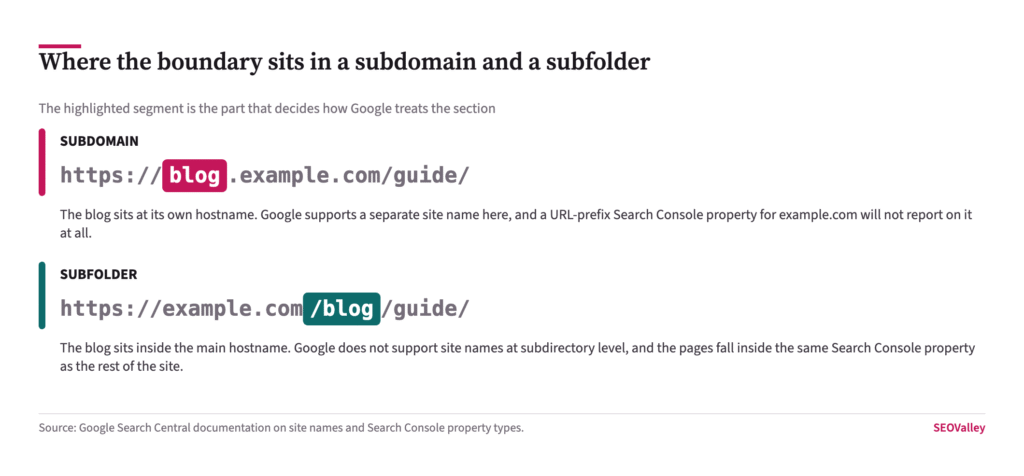
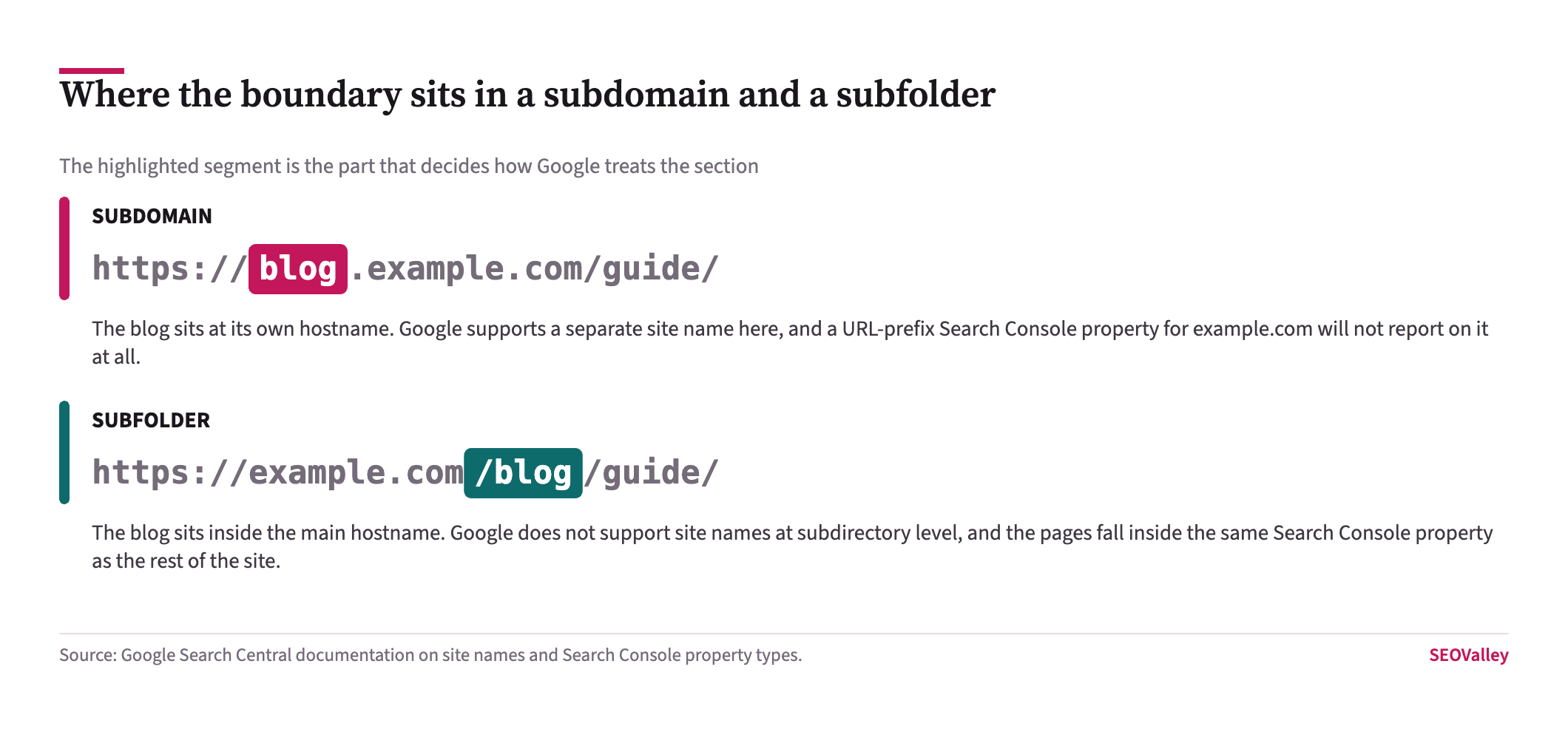
Key data: Google’s site names documentation states that site names can appear for domain-level and subdomain-level sites, and that Google Search does not support site names at the subdirectory level. So news.example.com can carry its own name in results; example.com/news cannot.
Why it matters: for a genuinely distinct property — a separate brand, a documentation portal, a regional storefront — the subdomain gives you a naming affordance the subfolder does not. That is a real reason to choose one, and it never appears in the authority argument.
The check: search for your subdomain’s home page and look at the name shown above the URL in the result. If it shows the parent brand where you wanted the sub-brand, add WebSite structured data with the name you want on that subdomain’s home page.
How does the choice change your Search Console reporting?
Substantially, and this is where most teams actually feel the decision. The property model draws its boundary at the hostname.
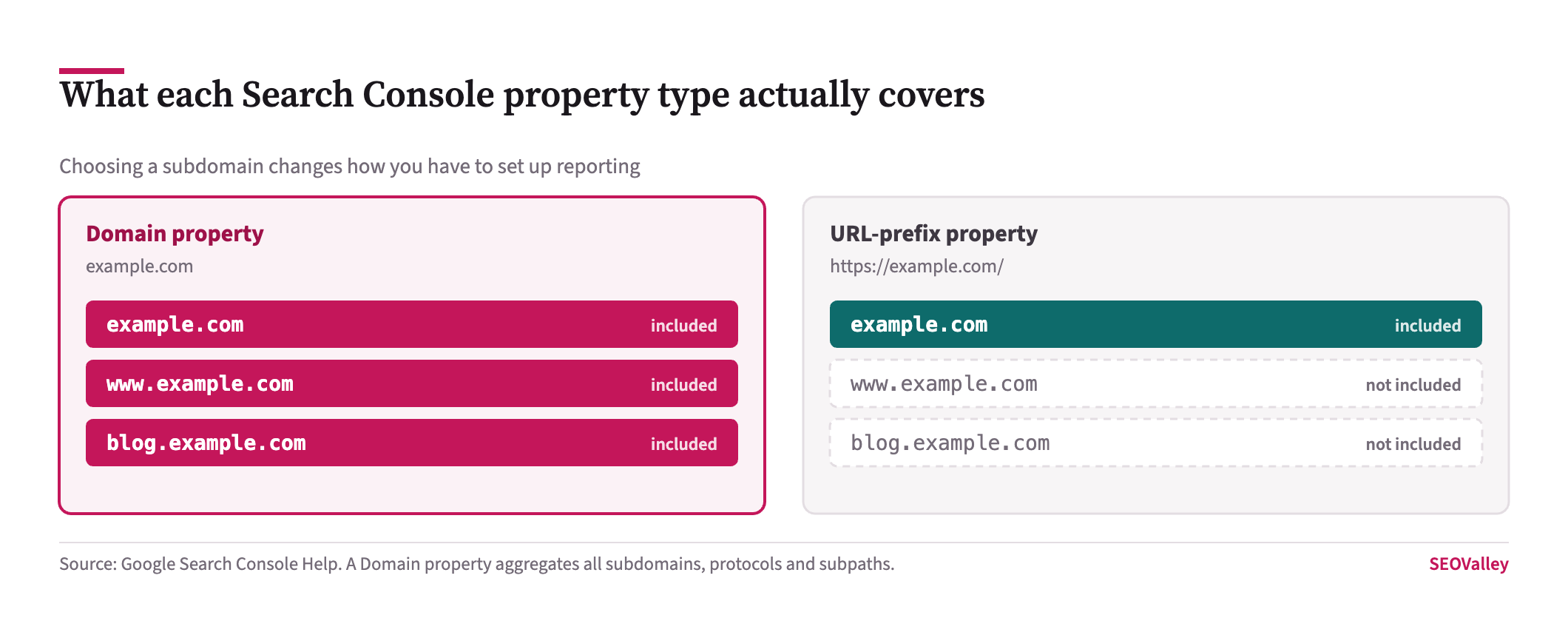
Key data: Search Console Help states a Domain property aggregates all subdomains, protocols and subpaths. A URL-prefix property includes only URLs matching that prefix, so a prefix property on https://example.com/ excludes blog.example.com entirely.
Why it matters: teams put a blog on a subdomain, keep reporting from an old URL-prefix property, and conclude the blog produces no search traffic. The blog was never in the dataset.
The check: open Search Console and look at the property selector. If the property is a URL-prefix type and you run any subdomain, verify a Domain property exists and switch your reporting to it. Verification needs DNS access, so raise it with whoever controls the domain records before you promise a date.
Does authority flow between a subdomain and the main site?
Nobody outside Google can answer this with evidence, and you should distrust anyone who says otherwise with confidence.
What is documented is narrow: Google says either structure is fine and gives no mechanism for transfer or dilution in either direction. What is observable is that subdomains of large sites do rank, often well, which is hard to reconcile with a heavy structural penalty.
Why it matters: this single unresolved question drives most subdomain migrations, and it is the one point on which no public evidence exists. Spending six weeks of engineering on an unfalsifiable claim is a poor trade when the operational reasons are measurable.
Where a real effect probably hides is internal linking. A subfolder tends to get linked from the main navigation because it feels like part of the site; a subdomain often does not. That is a design habit rather than an algorithm, and it is fixable without moving anything — the guidance on site structure and internal linking applies to a subdomain exactly as it does to a folder.
When is a subdomain the right answer?
When the section is genuinely a different thing, or when the alternative is a worse technical compromise.
A different technology stack that cannot sit behind the same server or CDN path. A separate team with its own deployment cycle, where coupling releases would slow both. A distinct brand that wants its own name in results. A regional or language property where you want independent hosting. A user-generated or partner-hosted area you want kept at arm’s length from the main hostname, which also reduces your exposure under Google’s site reputation abuse policy.
The check: ask whether a reader arriving on that section would consider themselves still on your website. If the honest answer is no, a subdomain reflects reality and will not confuse anyone.
When is a subfolder the right answer?
When the section is part of the same product story and the same team owns it. A blog that exists to support the main site’s commercial pages belongs in a subfolder, not because of authority, but because everything else is simpler: one property, one analytics view, one template, one set of navigation links, one certificate.
Key data: Google’s multi-regional and multilingual guidance lists a country subdirectory on a generic top-level domain, such as https://example.com/de/, among its recommended structures for regional targeting.
The check: count the systems. If moving the section into a folder removes a separate CMS, a separate certificate, a separate analytics property and a separate Search Console property, the operational case is made and you do not need a ranking argument.
What does a migration actually cost you?
A period of instability you cannot schedule, and a permanent redirect chain you have to maintain. Google processes a move at its own pace, and rankings fluctuate while it does.
Why it matters: the downside is certain and the upside is unproven. That asymmetry should make the default answer “leave it” unless an operational reason is driving the change.
The check: before committing, export twelve months of clicks and impressions for the affected URLs, and record the date you begin. Without that baseline, you will not be able to tell recovery from decline, and the same discipline that applies to any website migration checklist applies here.
If you do move, redirect one to one rather than to a category page, keep the old URLs resolving indefinitely, update internal links to point at the new destinations instead of relying on the redirects, and re-verify the destination in Search Console before launch. The same care that changing a domain name demands applies to a hostname change, because that is what this is.
How should you decide, in order?
Answer four questions and stop at the first that gives a clear answer. Does a separate team deploy it? Does it need a different stack or host? Does it need its own name in search results? Is it a different brand to a reader? Any yes points to a subdomain. All no points to a subfolder.
Nowhere in that sequence does ranking appear, which is the point. The ranking question has no public evidence behind it, and the operational questions have clear answers you can verify in an afternoon.
The differences that are actually documented
| Difference | Subdomain | Subfolder |
|---|---|---|
| Own site name in results | Supported by Google | Not supported at subdirectory level |
| Search Console URL-prefix property | Needs its own property | Covered by the parent property |
| Search Console Domain property | Included automatically | Included automatically |
| Ranking strength | No documented difference | No documented difference |
| Separate stack or deploy cycle | Straightforward | Requires shared routing |
| Google’s multi-regional recommendation | Listed as an option | example.com/de/ given as recommended |
Which structure for which situation
| Situation | Structure | Why | How to confirm |
|---|---|---|---|
| Blog supporting the main commercial site | Subfolder | One property, one template, navigation links follow naturally | Count the separate systems the subdomain would require |
| Documentation portal on a different stack | Subdomain | Independent deployment without coupling releases | Ask whether the docs can deploy behind the main host’s path routing |
| Sub-brand that needs its own name in results | Subdomain | Google supports site names at subdomain but not subdirectory level | Search the section’s home page and read the name shown above the URL |
| Language or country version, same stack | Subfolder | Listed in Google’s recommended multi-regional structures | Check hreflang returns correctly across the set |
| Partner, listings or user-generated area | Subdomain | Keeps loosely supervised content off the main hostname | Name the internal reviewer for that section; if there is none, separate it |
| Existing subdomain performing adequately | Leave it | Migration risk is certain, ranking gain is unevidenced | Export twelve months of clicks for those URLs before anyone proposes a move |
What to do if you are deciding this week
Treat the structure as an operations decision and the ranking argument as noise. Google has called the two roughly equivalent since 2012 and repeated it since; the differences you can actually verify are site names, Search Console property scope, hosting and ownership. None of those requires a theory about authority.
The single next action is to open Search Console and check whether your property is a Domain property. If it is a URL-prefix property and you run any subdomain, you are reporting on part of your site and calling it all of it. Fix that before you decide anything else, because your data is currently wrong.
What not to do: do not migrate on the strength of a case study chart, and do not migrate at the same time as a redesign — if you do, you will never know which one caused what followed. If the section is already on a subdomain and performing, leaving it alone is a legitimate answer. Where you do need the move, a technical SEO audit ahead of it will surface the redirect map and the internal links that need rewriting, and our blog marketing team can take the navigation and linking work that usually delivers the gain people credit to the URL.
About the author
Shabir MS leads SEOValley Solutions and has worked in search since 2005, running technical audits and site migrations for clients in the US, UK and Australia. He has supervised migrations in both directions and has yet to see one where the URL structure alone explained the outcome. Read more from Shabir MS.
Frequently asked questions
Is a subfolder better than a subdomain for SEO?
Google has described them as roughly equivalent since 2012 and repeated the position in 2017. No controlled public test has demonstrated a ranking difference between the two.
Do subdomains dilute domain authority?
Domain authority is a third-party tool metric, not a Google signal. Google has never described a mechanism by which a subdomain would drain ranking strength from the main site.
Why do migration case studies show traffic gains?
Because the move is usually bundled with other changes. Ahrefs identified six confounding factors, including redesigns, added internal links and increased publishing at the same time.
Can a subdomain have its own site name in Google?
Yes. Google supports site names at domain and subdomain level, and states explicitly that it does not support site names at the subdirectory level.
Does a Search Console property cover my subdomains?
A Domain property aggregates all subdomains, protocols and subpaths. A URL-prefix property does not, so each subdomain needs its own property under that type.
Which structure should I use for language versions?
Google’s multi-regional guidance lists a country subdirectory on a generic top-level domain, such as example.com/de/, among its recommended structures.
Should I move my blog from a subdomain to a subfolder?
Only if there is an operational reason: shared team, shared stack, simpler reporting. Migration risk is certain and the ranking gain is unevidenced.
What is the main risk of migrating?
A period of ranking instability you cannot schedule, plus a redirect map you maintain permanently. Export twelve months of clicks for the affected URLs first.
Does Google crawl subdomains separately?
Google publishes no preference on this and treats either structure as acceptable. Practical differences show up in reporting and verification rather than in crawling behaviour you can observe.
Should a partner or listings section sit on a subdomain?
Often yes. Keeping loosely supervised third-party content off the main hostname reduces exposure under Google’s site reputation abuse policy.
Can I change my mind later?
You can, but each move costs another period of instability. Decide on operational grounds once rather than chasing an unevidenced ranking theory twice.
What matters more than the URL structure?
Internal linking. A subfolder usually gets navigation links a subdomain does not, and that difference is fixable without moving anything.