+91 9893014167
 1 (888) 316-3286
 +44 20 3807 2189
 Chat on WhatsApp


Your rankings have held. Your clicks haven’t. And since 31 August, Google has put a switch in Search Console that takes your site out of AI Overviews and AI Mode altogether. It’s tempting to see that switch as a way to stop the AI from eating your traffic.
For almost every business that sells something, the answer is no, don’t opt out. The switch doesn’t remove the AI Overview; Google fills it with similar content from other sites, so you mostly hand your place to a competitor. The only real case belongs to ad-funded publishers, and even they should test one folder and wait for Google’s click data, due mostly from December, before switching off a whole domain.
Key facts
- Google’s Search Console Help page says the Search generative AI control went live for all websites worldwide on 31 August 2026, with inclusion as the default.
- Google’s help page says that if you opt out, content from other sites will still appear in AI Overviews and AI Mode and may look similar to yours.
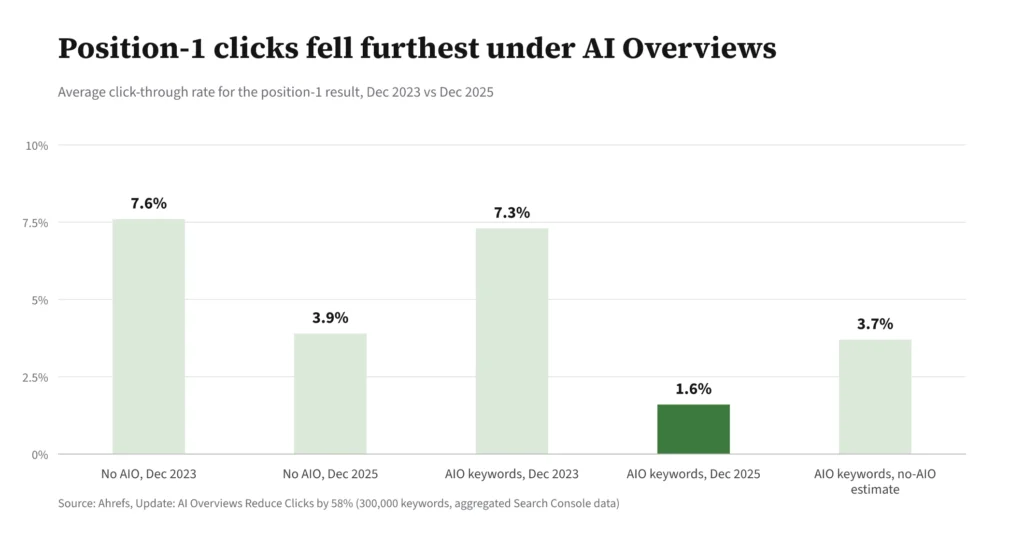
- Ahrefs reported in February 2026, updated October 2026, that the top-ranking page gets a 58% lower click-through rate when an AI Overview appears, across 300,000 keywords.
- Search Console’s Generative AI performance report, rolled out on 31 August 2026, shows impressions but no clicks or queries, according to Search Engine Roundtable on 1 September 2026.
- The Information reported in late September 2026, via Search Engine Journal, that Google’s AI contribution pilot pays some small and mid-sized sites under 0.1% of their ad revenue.
- Search Engine Journal reported in August 2026 that the UK’s CMA requires Google to share AI feature clicks and click-through rates, with most measures starting in December.
- Google said in June 2026, updated August 2026, that AI Overviews have more than 2.5 billion monthly active users and AI Mode has passed one billion monthly users.
This article explains what the new Search Console control actually does, why it won’t bring lost clicks back, what you would give up by using it, whether Google’s payment pilot changes anything, who has a genuine case for opting out, and what to do while the click data is still missing.
What does the new Search Console switch actually do?
It takes your site out of AI Overviews, AI Mode and the AI features in Discover, and very little else. According to Google’s Search generative AI control help page, the setting went live for every website worldwide on 31 August 2026. Being included is the default.
If you exclude your site, Google is blunt: “You won’t receive any traffic or impressions from these features.” Your content also stops being used to ground, or inform, the AI answers.
What it doesn’t do matters more:
- It doesn’t remove the AI answer. Google’s own words: “Content from other sites will still be available in those features, and it may appear similar to yours.”
- It isn’t a ranking signal anywhere else in Search, so your ordinary listings aren’t punished.
- It has nothing to do with AI training. That’s controlled separately through Google-Extended.
Changes take effect within one to two days, though caching can make some content take longer.
The scale explains why this is a real decision. Google’s announcement for website owners says AI Overviews have more than 2.5 billion monthly active users and AI Mode has passed one billion. Google also says it built the control while working with the UK’s Competition and Markets Authority. My read: this is a concession to a regulator, not a feature Google was keen to ship.
If I opt out, will my lost clicks come back?
No, because the AI Overview still appears; you’re simply no longer in it.
What it looks like: someone searches, an AI summary sits at the top, and it’s assembled from your competitors’ pages instead of yours. The searcher who might have clicked your citation now has one less reason to scroll.
Key data: Ahrefs studied 300,000 keywords using aggregated Search Console data and found that the top-ranking page gets a 58% lower click-through rate when an AI Overview appears, based on December 2025 data. Its April 2025 study had put the figure at 34.5%. The gap is widening, as their updated AI Overviews click study shows.
Why it matters: position-1 clicks fell on both sets of keywords, but much further where an AI Overview appeared, from 7.3% to 1.6%. Ahrefs estimates those keywords would have sat around 3.7% without one. Opting out doesn’t move you back towards 3.7%. The Overview is still there, still answering the question, just without your name on it.
It may get worse. Search Engine Roundtable spotted Google testing ordinary-looking links inside AI Overviews that open AI Mode instead of a website, and the test was seen on mobile by 13 October. If that rolls out, even cited pages lose some clicks. Uncited pages lose more. If your clicks are sliding for other reasons too, our list of reasons rankings hold while clicks keep falling is a better starting point than the opt-out switch.
What would you give up by opting out?
You’d give up being the source Google points to, and for a business that sells something, that citation is now one of the few ways to stay visible above the fold.
Our clearest evidence comes from SEOValley’s work with an Australian branded merchandise supplier. Over the past 12 months, the Australian Branded Merchandise Supplier lifted its top-5 Google rankings by 73%. AI answers in Google AI Overviews, AI Mode, ChatGPT and Perplexity now link to it as a source 1,906 times, and Google’s AI Overviews link to its pages for 1,581 different searches. Clicks from Google Search held steady at +5%, from 9,371 (June to September 2025) to 9,881 (June to September 2026). You can read how an Australian promotional products supplier earned 1,906 AI citations.
The lesson is simple. Being the cited source kept clicks steady while AI answers spread across its market. Opting out would have given up those 1,581 searches with nothing gained.
We’ve seen the same pattern elsewhere. For a UK automotive parts retailer, Google’s AI Overviews now link to its pages for 1,479 different searches, and clicks from Google Search in September rose 12%, from 5,530 to 6,190 (September 2025 against September 2026). Both are among our published case studies.
News sites have an extra risk. Search Engine Journal reported NewzDash figures showing that 15.5% of US trending-news results with Top Stories now show them inside AI Overviews (17.46% in the UK). Opting out could cost those placements too. Treat that carefully: NewzDash hasn’t published sample sizes, and Google hasn’t confirmed the effect.
Does Google’s AI payment pilot change the maths?
Not for most businesses, because the payments are small, unpredictable and invite-only.
Under Google’s AI contribution pilot, publishers earn when their content “contributes significantly” while an answer is being written in the Gemini app, AI Overviews or AI Mode. Being linked in an answer doesn’t count. Neither does being used to confirm a fact afterwards. Publishers can leave at any time, as Search Engine Roundtable reported and Semrush’s summary of the pilot confirms.
Now the money. The Information reported, as covered by Search Engine Journal’s write-up of the pilot payments, that Google is paying about 100 publishers. For several small and mid-sized sites, payments are under 0.1% of their ad revenue. Some smaller sites earned less than $1,000 over several months. One early participant earns more than $1 million a year. Payments change from month to month without explanation.
That’s not a business model. It’s a rounding error with a press release attached.
So the public argument about whether to “stay in and get paid” or “leave in protest” misses the point for anyone selling products or services. You aren’t in the pilot, the citation link itself earns nothing, and the real value of staying in is the visibility, not the cheque.
Why is it so hard to judge the impact right now?
Because Google is asking you to decide before it shows you what its AI features send you.
The Generative AI performance report rolled out to all sites on 31 August 2026. It shows impressions from AI Overviews and AI Mode, grouped by page, country, device and date. If two of your links appear in the same answer, it counts one impression. A new “Web: multimodal” filter covers image searches from Google Lens, Circle to Search, uploaded images and Chrome image search.
What’s missing is the useful part. As Search Engine Roundtable noted at launch, there are no clicks and no queries. You can see you were shown. You can’t see whether anyone came.
That should change. Search Engine Journal reported in August that the CMA requires Google to share clicks and click-through rates, with most measures starting in December. The regulator’s own page is the place to confirm those dates as they approach.
Bing is already ahead here. According to Search Engine Land’s report on Bing’s Topics Portfolio, Bing Webmaster Tools reports citations and the searches where Copilot used your site, now grouped into topics in a beta view. Google reports only impressions.
One more gap, and it’s the big one. We couldn’t find any published before-and-after data from a site that actually opted out. NewzDash has said it plans to test this. Until someone does, anyone telling you opting out “works” is guessing.
Who has a genuine case for opting out?
Publishers whose content is the product, mainly ad-funded answer pages where the AI summary fully replaces the visit.
If your revenue depends on someone landing on a page to read a definition, a recipe step or a quick fact, and the AI Overview now gives them that fact in full, the citation may be worth very little to you. Being used to ground an answer that keeps people off your site is a poor trade. That’s a fair argument.
Even then, I wouldn’t switch off a whole domain. Google’s help page explains that a URL-prefix property, such as example.com/blog/, inherits its parent’s setting by default but can be set separately. That means you can opt out one folder and leave the rest alone.
Pick a section where you suspect the AI answer is doing the most damage, exclude it, and watch what happens to its traffic against a similar folder that stays in. Then compare again once click data arrives in Search Console. Search Engine Journal also reports that page-level controls are due by March 2027, which will make this kind of test far more precise.
For everyone else (shops, service businesses, B2B suppliers, local firms), the visit was never the whole value. Being named as the source, in front of more than 2.5 billion monthly users, is a brand impression you’d struggle to buy.
| Option | Does the AI answer still appear? | Can your site appear in it? | Effect on normal rankings | Who it suits |
|---|---|---|---|---|
| Stay in (default) | Yes | Yes | None | Almost every business that sells something |
| Opt out whole domain | Yes, built from other sites | No, and no AI traffic or impressions | None, per Google | Very few sites, and only with evidence |
| Opt out one folder (URL-prefix property) | Yes | Only outside that folder | None, per Google | Ad-funded publishers testing the impact |
| Stay in and join the AI contribution pilot | Yes | Yes | None | Invited publishers; payouts reported as tiny |
What should you do before the December click data arrives?
Stay in, measure what you can, and make your pages more worth citing.
- Check your AI impressions now. Open the Generative AI performance report and see which pages already appear in AI Overviews and AI Mode. Our guide on measuring AI visibility when there is no rank to track covers what to look at.
- Record a baseline. When clicks and click-through rates appear, you’ll want something to compare them with.
- Look at what’s being cited instead of you. If competitors fill the Overviews for your key topics, that’s the gap to close. We broke down what gets cited in AI Overviews and how it changes by query.
- Don’t confuse the controls. If your worry is AI training, that’s Google-Extended, not this switch. If you sell products, Shopping and Ads are a separate conversation, which we covered in whether SEO is still worth it for ecommerce now Google answers with AI.
- If you’re a publisher, test one folder only. Use a URL-prefix property and give it time before drawing conclusions.
The switch is easy to flip and the effect shows within days. That’s exactly why it deserves patience. You’d be making a permanent-feeling choice on half the data.
My advice for this quarter is short. Leave the switch where it is, start reading your AI impressions now, and use the December click data to make a decision on evidence rather than frustration. If you’re an ad-funded publisher, test one folder, not the whole site.
The businesses holding their clicks right now are the ones being cited, not the ones hiding. If you want to know where your site stands in AI Overviews and AI Mode, and what it would take to become the source Google names, take a look at our AI SEO services.
About the author
Shabir MS leads SEOValley Solutions and has worked in search since 2005. These days most of his time goes on how brands show up in AI answers, and on separating what the data actually shows from what gets said at conferences. Read more from Shabir MS.
Frequently asked questions
If I opt out of AI Overviews, will my lost clicks come back?
No. Google’s help page says the AI answer still appears using content from other sites, which may look similar to yours. You simply stop appearing in it and stop receiving any traffic or impressions from it.
Will opting out hurt my normal Google rankings?
Google says the control is not a ranking signal anywhere else in Search. Your ordinary listings should be unaffected.
Is this the same as blocking Google-Extended or using nosnippet?
No. Google-Extended controls whether your content is used for AI training, which this switch doesn’t touch. Nosnippet is a blunter tool that also removes your normal search snippets.
Can I opt out only part of my site, such as the blog?
Yes. A URL-prefix property such as example.com/blog/ can be set separately from the rest of the domain. Search Engine Journal reports that page-level controls are due by March 2027.
Can I get paid through Google’s AI contribution pilot?
The pilot covers about 100 publishers and isn’t open to everyone. The Information reported that several small and mid-sized sites earn under 0.1% of their ad revenue from it, and being linked in an answer earns nothing.
Does this switch affect ChatGPT, Perplexity or Copilot?
No. It covers Google’s AI Overviews, AI Mode and Discover’s AI features only. Other AI tools need their own controls, and Bing Webmaster Tools already reports Copilot citations.