Last updated: 19 September 2026
Your team has been drafting with AI for a year. Traffic has not collapsed, but it has not moved either, and nobody can say whether the tool is the reason.
The stakes are not theoretical. Google’s scaled content abuse policy carries manual actions, and a site that trips it can lose its rankings rather than merely drift down them.
Google does not penalise content for being written with AI. It penalises pages produced in volume with little originality and little value, and its spam policy says explicitly that this applies no matter whether the content came from automation, humans, or a mix. The tool is not the offence. The absence of anything worth reading is.
Key facts
- Google’s scaled content abuse policy, published on 5 March 2024, defines the violation as generating many pages “for the primary purpose of manipulating Search rankings and not helping users”, and applies it regardless of whether the content was produced by automation or by people.
- Google’s guidance on generative AI content states that using AI tools to generate many pages without adding value for users may violate that policy — the volume and the emptiness are the trigger, not the tooling.
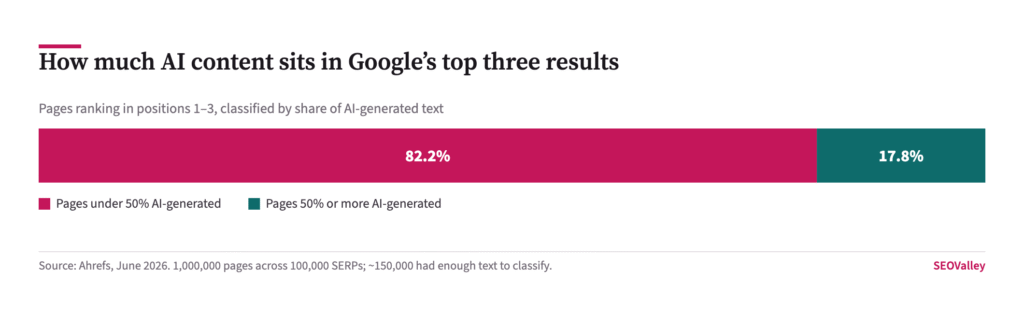
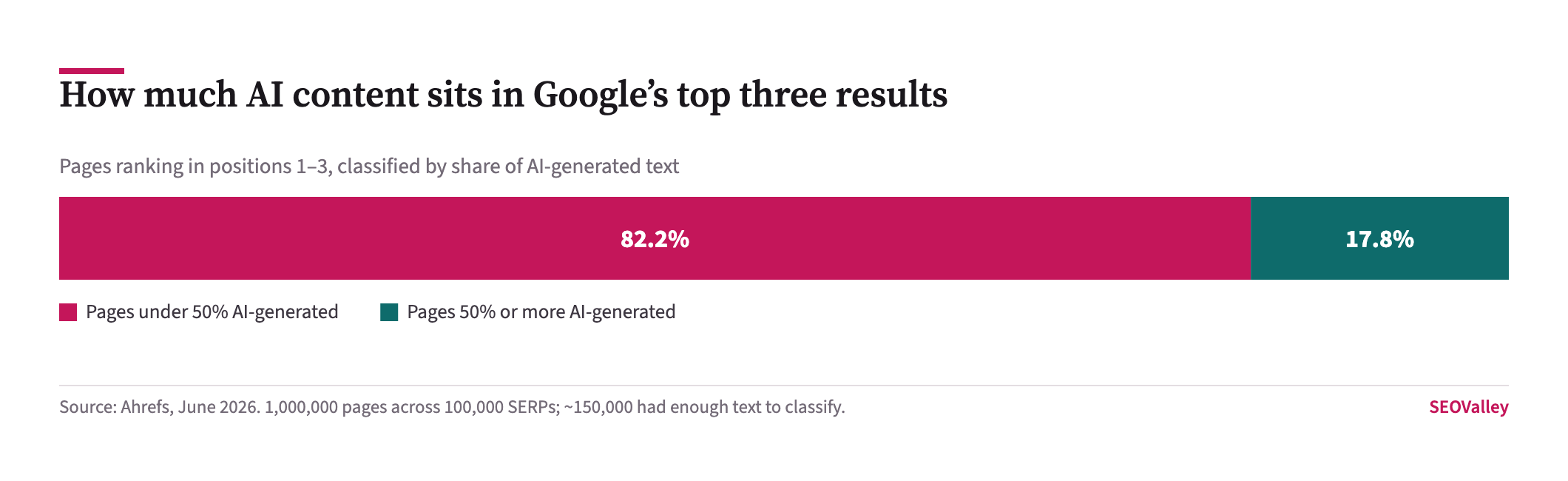
- Ahrefs analysed 1,000,000 pages drawn from the top ten results across 100,000 SERPs in June 2026 and found 82.2% of pages ranking in the top three were under 50% AI-generated.
- In that same Ahrefs dataset, only 5.3% of top-three pages were classified as entirely AI-generated.
- Average AI content across the top ten barely shifted with rank, moving from 27.1% at position one to 30.9% at position ten.
- Pages with low AI content were indexed at 49.28% against 40.35% for pages with very high AI content, on Ahrefs’ crawl.
- Graphite analysed 43,000 URLs sampled from CommonCrawl and found the volume of AI-generated articles published on the web overtook human-written articles in November 2024.
This article covers what Google’s policies actually prohibit, what the ranking data shows about AI-written pages, and where the practical line sits for a team that wants to use these tools without putting the domain at risk. It moves from policy to evidence to process.
Does Google penalise content because it was written by AI?
No. Google’s guidance on generative AI content permits it and asks only that the result meets the Search Essentials and the spam policies. The condition is the output, not the process.
What it looks like: a board paper asserting that AI drafting is an SEO risk in itself, usually with no policy citation attached.
Key data: the scaled content abuse policy states it applies “no matter whether content is produced through automation, human efforts, or some combination of human and automated processes”.
Why it matters: a blanket internal ban costs you the legitimate uses — research summarisation, first drafts, translation, schema generation — while doing nothing about the actual risk, which is publishing volume without judgement.
The check: read the last ten pages your team published and ask, for each, what a reader gets there that they cannot get from the first page of results. If the honest answer is nothing, the page is a liability whoever typed it.
What does Google actually prohibit?
Three named practices, set out in the Google Search spam policies and introduced with the March 2024 core update and spam policies. Only one of them is about content production at scale.
Scaled content abuse covers many pages generated primarily to manipulate rankings rather than help users, typically large amounts of unoriginal content. Site reputation abuse covers third-party pages published with little first-party oversight to exploit the host’s ranking signals. Expired domain abuse covers buying a lapsed domain to trade on its former reputation.
Why it matters: the middle one catches a tactic that has become common — letting an agency or partner publish onto your domain with no editorial involvement. Google says the policy does not treat all third-party content as a violation, only content hosted without close oversight and intended to manipulate rankings.
The check: list every directory, guest section, coupon page and partner subfolder on your domain. For each, name the person on your staff who reviews what goes live. Where there is no name, you have a site reputation abuse exposure regardless of how the content was written.
Do AI-written pages rank?
Some do, and fewer than the volume of AI publishing would suggest. Ahrefs sampled 1,000,000 pages from the top ten across 100,000 SERPs in June 2026 and classified those with enough text to assess.
Key data: 82.2% of top-three pages were under 50% AI-generated, and 5.3% were classified as entirely AI-generated. So heavily AI-written pages do reach the top three — they are simply outnumbered.
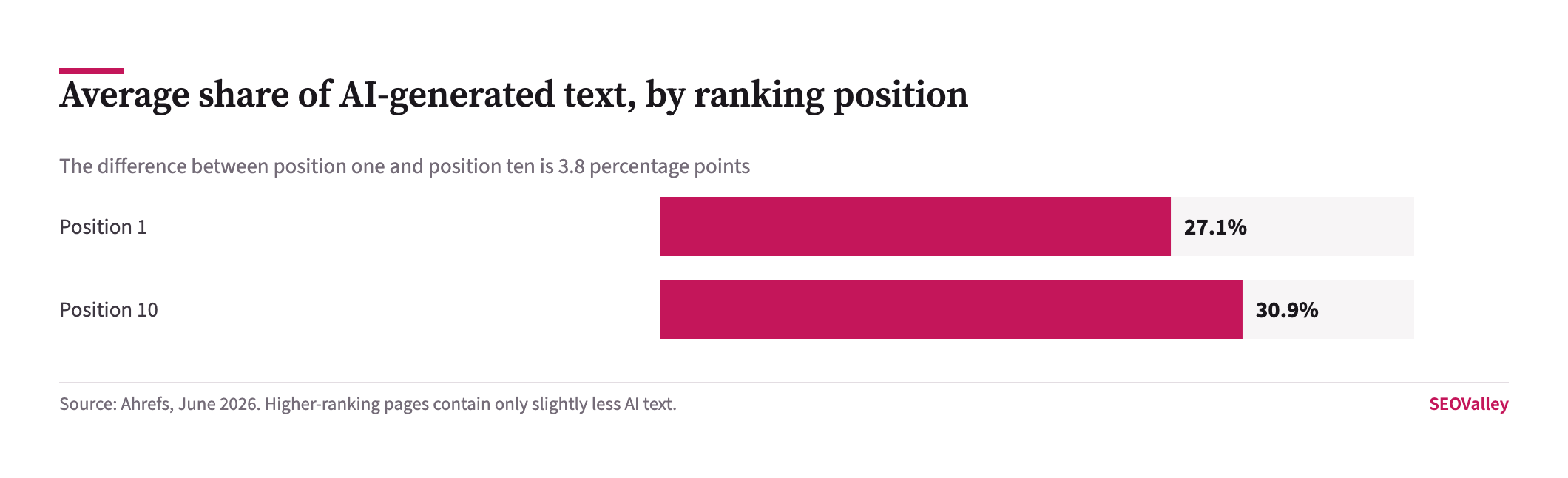
Why it matters: the near-flat line above is the more useful finding. If AI text were itself a ranking signal, position one and position ten would look very different. They differ by 3.8 percentage points.
Read the methodology before repeating the numbers. Ahrefs used its own detector on pages of at least 350 words and said plainly that AI detection is imperfect and that its method differs from Google’s. The finding is a correlation in a sample, not a measurement of Google’s behaviour.
Is there any measurable penalty at all?
A visibility gap rather than a penalty, and it shows up before ranking. In the same Ahrefs crawl, pages with low AI content were indexed at 49.28%, against 40.35% for pages with very high AI content.
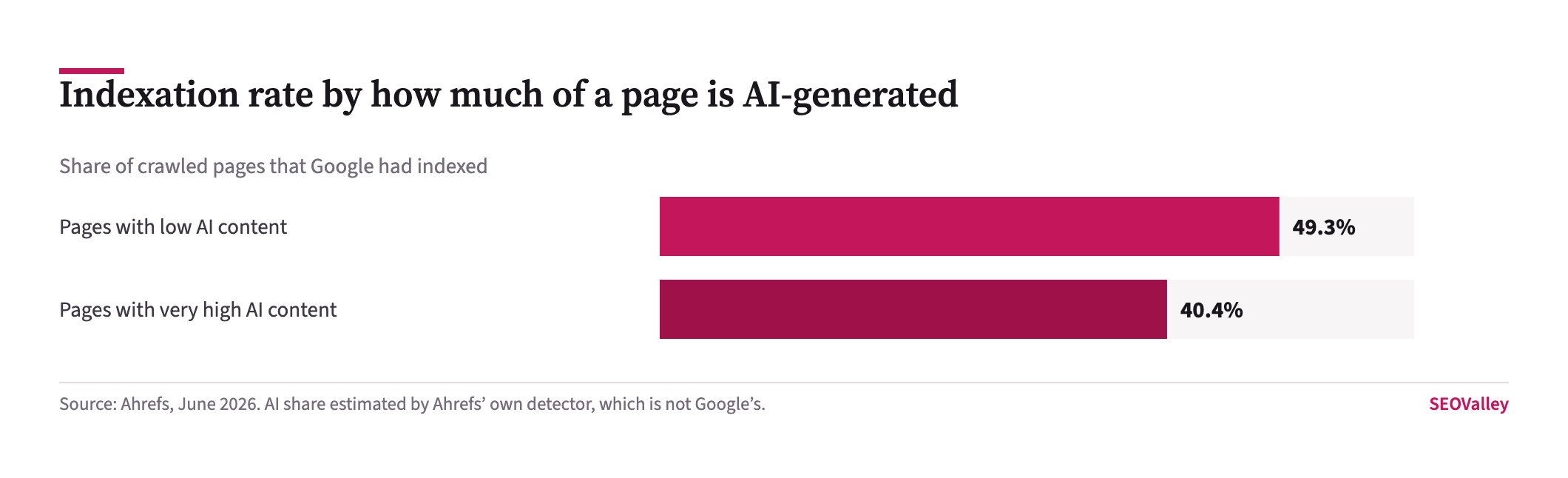
Why it matters: an unindexed page cannot rank, cannot be cited and cannot be attributed. Teams measuring only rankings will miss this entirely, because the affected pages never enter the dataset they are looking at.
The check: in Search Console, open Pages under Indexing and read the “Crawled – currently not indexed” and “Discovered – currently not indexed” groups. Cross-reference those URLs against your publishing log. If your AI-assisted pages cluster there, you have your answer without needing anyone else’s study.
Ahrefs also found low and moderate AI pages drew two to three times the organic impressions of high AI pages, while noting high-AI pages did not fall off over time. Both things can be true: a lower ceiling, not a cliff.
How much of the web is AI-written now?
More than half of new articles, and the share has stopped climbing. Graphite sampled 43,000 URLs from CommonCrawl — English articles carrying article schema, at least 100 words, published between January 2020 and May 2025.
Key data: AI-generated articles overtook human-written articles by volume in November 2024. The proportion then held roughly steady for the following twelve months rather than continuing to rise.
Why it matters: the plateau is the interesting part. Graphite’s own reading is that practitioners discovered AI content underperforms in search and stopped scaling it. That is a market correcting, not a policy working.
Treat the figure with the caution its authors do. Detection was by Surfer’s tool at a 50% threshold, with a measured 4.2% false positive rate against pre-ChatGPT articles. Any study of this kind is estimating, and a study that publishes its error rate is more trustworthy than one that does not.
Should you disclose that content was AI-assisted?
Google suggests considering it, in a way that suits your audience, and stops short of requiring it for ordinary articles. The requirements are narrower and specific.
Key data: Google’s guidance asks e-commerce operators to label AI-generated images with IPTC metadata and to specify and label AI-generated product data separately.
Why it matters: a blanket “written with AI assistance” badge on every page tells a reader nothing useful and can undercut the authorship signals you want. A named author with real credentials does more work.
The check: for each article, can you name the person accountable for its accuracy? If yes, put that person in the byline and give them an author page. If no, the disclosure question is the wrong problem to be solving.
Where a claim rests on first-hand experience, say whose. That framing is both a trust signal and an honest statement of where the claim came from, and it is the part an AI draft cannot supply for you.
Which SEO tasks is AI genuinely good at?
The ones where the output is checkable and the cost of an error is low. Schema generation, internal-link candidate lists, meta description variants, clustering a keyword export, summarising a competitor set, drafting FAQ answers from an article you already wrote.
Why it matters: these are the tasks where a human verifies in seconds. The failure mode of a wrong JSON-LD block is a validator error, not a false claim published under your name.
There is a second category worth naming: tasks where the model is a reader rather than a writer. Pasting a competitor page in and asking which questions it fails to answer is fast, checkable and produces a brief rather than prose. The same applies to auditing your own page against the query it targets.
The inverse holds for anything requiring a number, a date, a quotation or a legal statement. Models produce plausible statistics with confident attributions, and a fabricated figure on an agency site is worse than a thinner page. Every statistic in this article was checked against its named source before it was written down.
What does a safe publishing process look like?
Four controls, none of which depend on detecting AI text.
Cap volume against capacity. If nobody on staff can review twenty articles a month properly, publishing forty is the risk, whatever wrote them. Scaled content abuse is a policy about volume without value.
Require a source for every factual claim, linked to the primary research rather than to a blog summarising it. This single rule eliminates most of what makes AI drafts dangerous.
Require something the model could not have: your own test, your own client pattern, your own screenshot of the actual tool. A page that adds nothing to what already exists is thin whether a person or a model wrote it.
Name an accountable editor per page, not per programme. Diffusion of responsibility is what turns an assisted draft into an unreviewed one, and it is the mechanism behind most of the sites that have been caught by the volume policies rather than any deliberate decision to spam.
Audit what is already live before publishing anything new. Our SEO audit work regularly finds that the fastest gain is removing or merging pages rather than adding them, and refurbishing older content that already has authority usually beats a new draft.
Where AI assistance is safe, and where it is not
| Task | Risk level | Why |
|---|---|---|
| Generating JSON-LD schema | Low | Output is machine-checkable; a validator catches every error |
| Clustering a keyword export | Low | You can read the clusters and correct them in minutes |
| Drafting meta descriptions | Low | Short, reviewable, and no factual claims involved |
| Summarising a competitor page | Low | The source is in front of you while you check it |
| Writing statistics or dates | High | Models produce plausible figures with confident false attributions |
| Legal, medical or financial claims | High | YMYL territory where an error carries real-world consequences |
Symptom, cause and how to confirm it
| Symptom | Likely cause | How to confirm |
|---|---|---|
| New articles never appear in Search Console | Crawled or discovered but not indexed | Search Console, Indexing, Pages — check the not-indexed groups against your publishing log |
| Published volume rose, impressions flat | Unoriginal pages competing with your own | Compare impressions per published URL before and after the volume increase |
| Sudden sitewide ranking loss | Possible manual action | Search Console, Security & Manual Actions — a spam manual action is reported there |
| Partner or guest section outranks core pages, then the site drops | Site reputation abuse exposure | List third-party sections and name the internal reviewer for each |
| Pages read fluently but convert poorly | No first-hand substance behind the prose | Ask what the page contains that is not in the top ten results already |
| A statistic in your content cannot be traced | Fabricated figure from a draft | Search the exact claim; if no named organisation published it, remove it |
What to change on Monday
Google draws its line at scaled, unoriginal, low-value publishing, and says in its own policy that the line applies the same way to human and machine output. The ranking evidence agrees: Ahrefs found the average share of AI text differs by under four percentage points between position one and position ten, so the text’s origin is not what is sorting the results.
The single next action is to pull your not-indexed URLs from Search Console and check whether your recent output clusters there. That is a first-party answer about your own site, and it costs ten minutes.
What not to do: do not run your pages through an AI detector and rewrite to beat the score. Detectors are unreliable in both directions, Google does not use them, and rewriting for a score degrades the prose without changing anything Google measures. Do not ban the tools either — the teams getting hurt are the ones that raised volume, not the ones that raised assistance. If you want the output checked properly, our blog marketing team works to a sourced-claims standard, and the companion piece on what actually works in generative engine optimisation covers the other half of this question: being cited by AI rather than writing with it.
About the author
Shabir MS leads SEOValley Solutions and has worked in search since 2005, overseeing content audits and technical SEO for clients in the US, UK and Australia. He has spent the past two years auditing sites that scaled AI-assisted publishing, which is where the indexation checks in this article come from. Read more from Shabir MS.
Frequently asked questions
Does Google penalise AI-generated content?
No. Google penalises scaled, unoriginal, low-value pages. Its spam policy states the rule applies whether content came from automation, human effort, or a combination of the two.
What is scaled content abuse?
Generating many pages primarily to manipulate Search rankings rather than help users, typically large volumes of unoriginal content. Google published the policy on 5 March 2024.
Can AI-written pages rank in Google’s top three?
Yes. Ahrefs found 5.3% of top-three pages were entirely AI-generated, though 82.2% of top-three pages were under 50% AI-generated.
Does AI content rank worse than human content?
Rank barely separates them. Average AI share moved from 27.1% at position one to 30.9% at position ten in Ahrefs’ June 2026 sample of a million pages.
Is there any measurable downside to heavy AI content?
Indexation. Ahrefs found 49.28% of low-AI pages were indexed against 40.35% of very-high-AI pages, so the gap opens before ranking is decided.
How much of the web is written by AI?
Graphite’s sample of 43,000 CommonCrawl URLs found AI-generated articles overtook human-written ones by volume in November 2024, then held roughly steady for a year.
Should I label content as AI-generated?
Google suggests considering a note on how content was created. It specifically asks e-commerce sites to label AI-generated images with IPTC metadata and AI-generated product data separately.
Do AI content detectors matter for SEO?
No. Google does not use them, and they misclassify in both directions. Rewriting to beat a detector score degrades the writing without changing anything Google measures.
What is site reputation abuse?
Publishing third-party pages with little first-party oversight to exploit the host site’s ranking signals. Google does not treat all third-party content as a violation, only unsupervised content intended to manipulate rankings.
How do I know if I have been hit by a spam action?
Check Security & Manual Actions in Search Console. A spam manual action is reported there, and you can submit a reconsideration request once the issue is fixed.
Which SEO tasks are safe to use AI for?
Ones with checkable output: schema generation, meta description variants, keyword clustering, internal-link candidates and FAQ answers drawn from an article you already wrote.
What is the biggest risk when drafting with AI?
Fabricated statistics presented with confident attribution. Require every factual claim to link to the named primary source, and delete any figure you cannot trace.