Last updated: 19 September 2026
Someone has sent you an audit with a low E-E-A-T score and a recommendation to improve it. Nobody in the room can say what would change on the page.
That vagueness has a cost. E-E-A-T work is easy to scope as strategy, price as strategy, and finish with nothing anyone can point at. It does not have to be that way, but it needs a definition of done.
E-E-A-T is not a score and not a ranking factor. Google says so directly, and adds that trust is the part that matters most. What you can actually build is the evidence a reader and a machine both use to judge trust: a named author who exists elsewhere on the web, correct author markup, and claims that carry a source. That work is concrete and checkable.
Key facts
- E-E-A-T stands for experience, expertise, authoritativeness and trustworthiness, per Google’s documentation on creating helpful, reliable, people-first content.
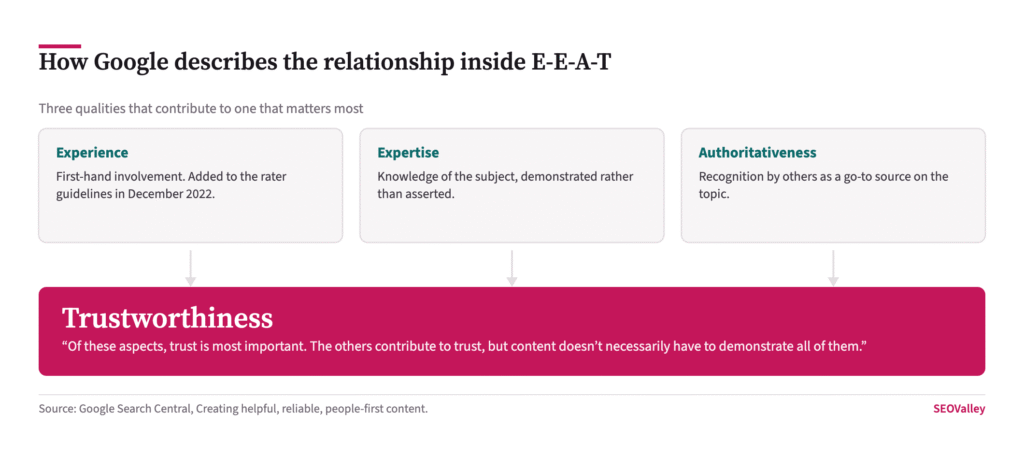
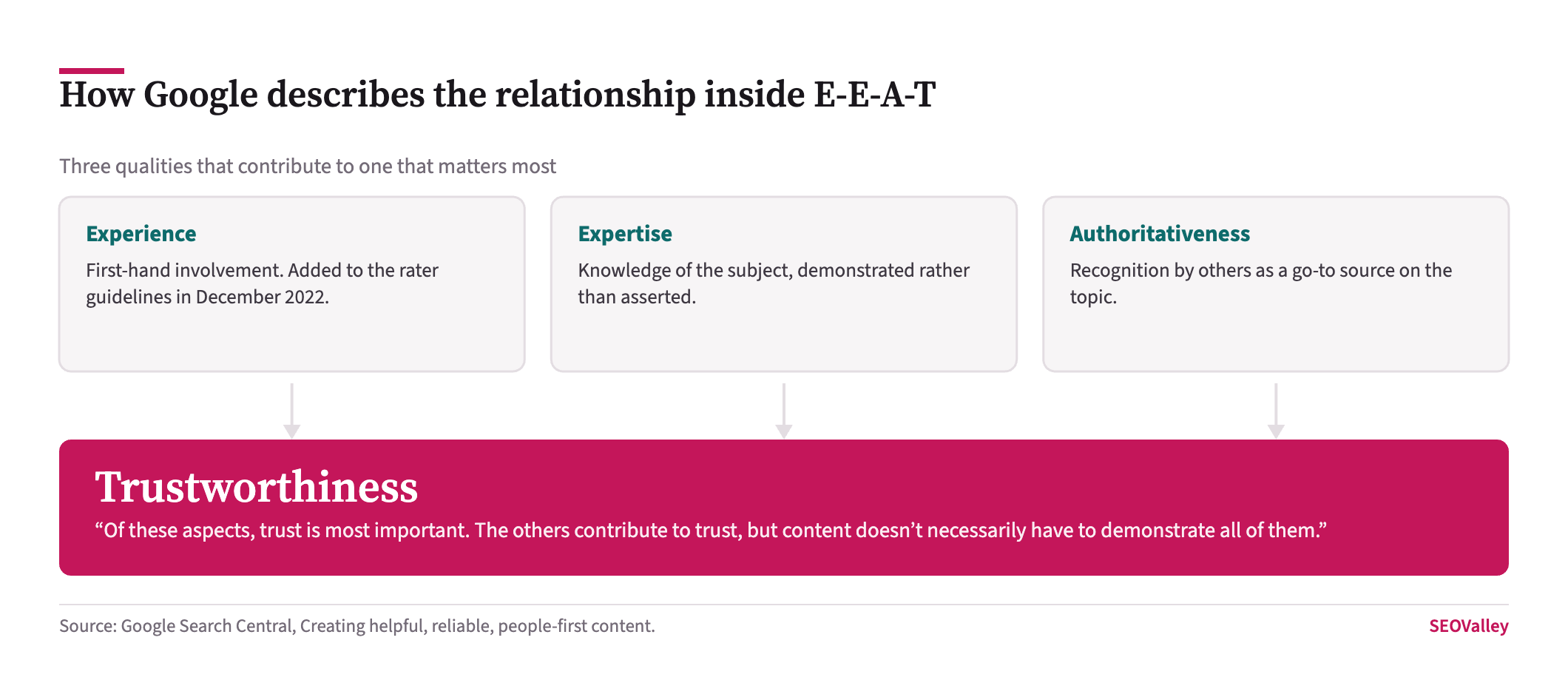
- Google states: “Of these aspects, trust is most important. The others contribute to trust, but content doesn’t necessarily have to demonstrate all of them.”
- Google states that “while E-E-A-T itself isn’t a specific ranking factor, using a mix of factors that can identify content with good E-E-A-T is useful”.
- The extra E for experience was added to the quality rater guidelines in December 2022.
- Google states that rater data “is not used directly in our ranking algorithms”, comparing it to feedback cards a restaurant collects from diners.
- Google weights E-E-A-T more heavily for Your Money or Your Life topics, defined as those that could significantly affect health, financial stability, safety, or the welfare of society.
- Google’s Article structured data guidance states that in author.name you should “only specify the name of the author” and add no other information.
This article separates what Google actually says from what the audit tools imply, then covers the markup, the author infrastructure and the editorial practices that produce evidence rather than assertions.
Is E-E-A-T a ranking factor?
No, and Google is unusually direct about it. Its guidance on helpful content says E-E-A-T itself is not a specific ranking factor, while a mix of factors that identify content with good E-E-A-T is useful.
What it looks like: a report giving your site an E-E-A-T score out of 100, usually generated by a tool that cannot see anything Google sees.
Why it matters: there is no E-E-A-T number inside Google to improve. A tool’s score measures that tool’s heuristic, and moving it proves only that you satisfied the heuristic.
The check: ask what specific page change the score recommends and what signal it claims that change sends. If the answer is “add an author bio”, that is a reasonable change with an honest rationale. If the answer is “raise the E-E-A-T score”, it is circular.
Do quality raters affect my rankings?
Not directly, and this is the most persistent misunderstanding in the field. Google compares rater feedback to the cards a restaurant collects from diners: it informs whether changes to the recipe worked, and it does not decide what any individual diner is served.
Key data: Google states that rater data is not used directly in its ranking algorithms.
Why it matters: it follows that no page was ever demoted by a rater, and that the rater guidelines are a description of what Google wants its systems to reward rather than a checklist the systems apply. Reading them is useful; treating them as an audit rubric is not.
Which part of E-E-A-T should you work on?
Trust, because Google says the other three contribute to it and that content need not demonstrate all of them.
Why it matters: most E-E-A-T programmes start with authoritativeness, which is the slowest and most expensive to build, and skip trust signals that can be fixed this week. A missing returns policy, an unreachable contact address, an unsigned article and an uncited statistic are all trust failures, and all are cheap to correct.
The check: open your highest-value commercial page as a stranger. Can you find who wrote it, who the company is, where they are, how to reach a human, what happens if the product is wrong, and where the claims come from? Every no is a task, and none of them require a content strategy.
What does experience mean, and how do you show it?
First-hand involvement with the thing being described, added to the rater guidelines in December 2022 precisely because expertise alone was letting well-researched but second-hand content outrank people who had actually done it.
What it looks like: a page that could only have been written by someone who used the product, ran the process or visited the place.
The check: find the sentence in your article that a competent writer could not have produced from the first page of Google results. If there is not one, the page has no experience signal, and adding a bio will not create one. Original screenshots, your own test numbers, the specific screen and setting, the thing that went wrong — these are the evidence.
This is also the part that survives the arrival of AI drafting, since a model cannot supply first-hand experience it never had. It is the same distinction that decides whether AI-assisted content earns its place or becomes the unoriginal volume Google’s spam policies target.
What author markup does Google actually document?
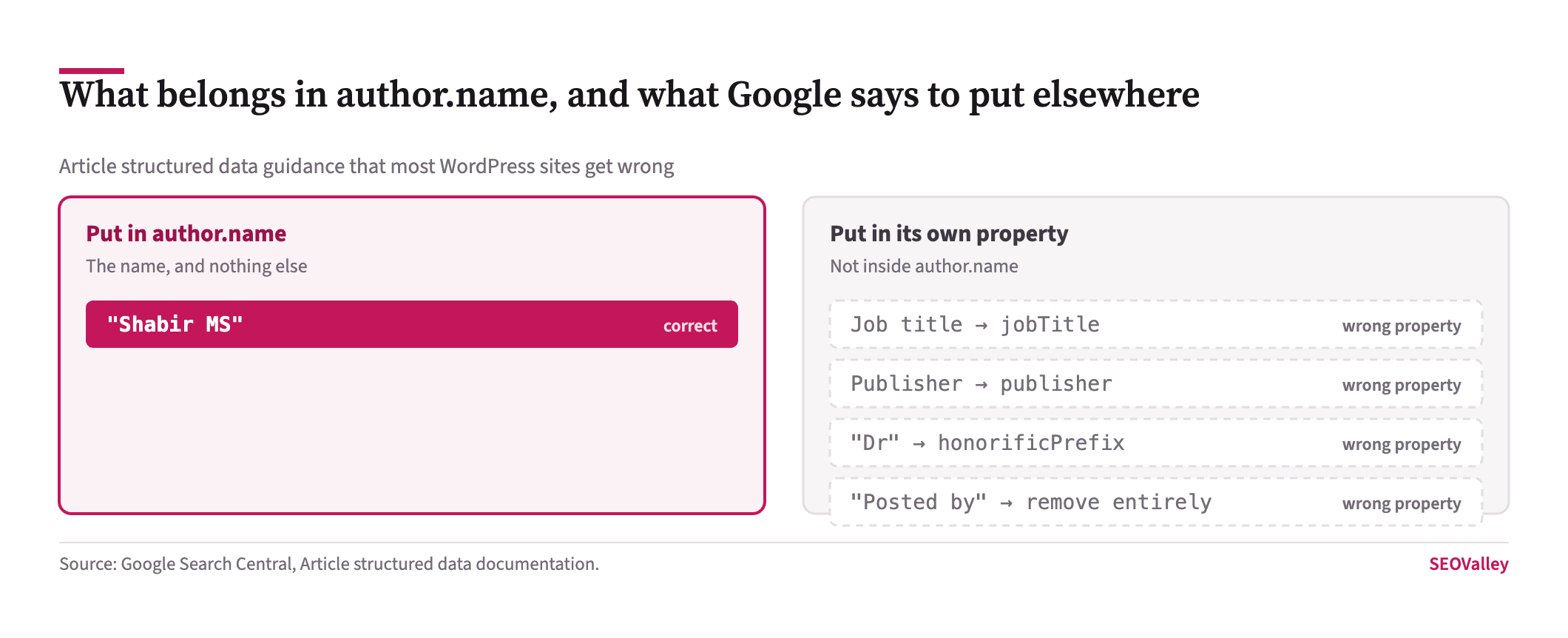
Article structured data with a properly formed author property, and Google is specific about how to form it.
Key data: in author.name, specify only the author’s name. Job titles belong in jobTitle, the publisher belongs in publisher, honorifics belong in honorificPrefix or honorificSuffix, and introductory words such as “posted by” should not be there at all. Use the Person type for people and Organization for organisations, never Thing. List multiple authors as separate entries rather than one combined string.
Why it matters: most WordPress themes emit author.name as “Posted by Dr Jane Smith, Head of Research, Acme”, which Google’s documentation rules out on four separate counts. That is a real defect you can fix, unlike a score.
The check: run a published article through the Rich Results Test and read the author object it reports. Then view source and confirm author.url points at a genuine author page rather than at the post itself.
Be honest about what this buys. Google documents author markup as a way to understand and represent authorship; it does not claim it lifts rankings. Correct markup removes ambiguity, and that is the whole of the claim. Our guide to structured data covers the surrounding types.
What makes an author page worth having?
Evidence that the person exists beyond your domain. An author page that says only “Jane writes about marketing” is a placeholder, and adding one to every post creates volume rather than trust.
The check: a useful author page names the person’s role and tenure, states what they have actually done rather than what they are interested in, links out to profiles that corroborate it, and lists their articles. Then mark it up as a Person with sameAs links to those external profiles so the entity resolves to one identity rather than several.
Why it matters: an entity that cannot be corroborated anywhere else is an assertion. One that appears consistently on a professional profile, a conference listing, a published paper or an industry publication is a claim someone could verify — which is what trust means in practice. The related idea of how Google treats entities is the same mechanism applied to people.
Do you need a reviewer as well as an author?
On pages where an error could cause harm, yes, and the reviewer has to be a different person from the writer for the credit to mean anything.
What it looks like: a medical, legal or financial page carrying a line naming who checked it, when, and what qualifies them to check it.
Why it matters: a reviewer credit is a claim about process rather than about prose, and it is the clearest way to show that accuracy was somebody’s job. It also creates an internal obligation: naming a reviewer means the review has to actually happen.
The check: pick your three highest-risk pages and ask who signed off on the facts. If the answer is the writer, or nobody, add a review step and a visible review date before adding anything else. A review date that never changes is worse than none, so set a cadence you will keep.
Which pages does this matter most for?
Your Money or Your Life pages, which Google defines as topics that could significantly affect health, financial stability, safety, or the welfare of society.
Why it matters: the effort is not evenly distributed. A recipe page and a page about choosing a pension are not held to the same standard, and treating them identically wastes budget on one and underserves the other.
The check: sort your pages by whether a reader could be harmed by acting on bad information. Those at the top get named expert authors, review dates, citations and a reviewer credit. The rest get a competent byline and accurate sources.
What should you stop doing?
Adding author boxes to pages nobody reads, in the hope of a sitewide signal. Commissioning work priced against a tool’s E-E-A-T score rather than against a list of page changes. Marking up authors who are pen names with no external presence, which creates an entity that resolves to nothing.
And inventing credentials. A fabricated bio on a page about a YMYL topic is a trust failure of exactly the kind the framework exists to catch, and it is the one mistake here that can do lasting damage.
How do you build authoritativeness without buying it?
Slowly, and off your own domain. Authoritativeness is other people treating you as a source, which means it cannot be added to a page in a sprint.
What it looks like: your data quoted in an industry publication, your team cited in someone else’s research, your name on a conference programme.
Why it matters: this is the component that budgets consistently overspend on and misdirect. Paid placements and syndicated guest posts produce links without producing recognition, and Google’s site reputation abuse policy now targets exactly that pattern.
The check: search your own brand plus a topic term and look at who is talking about you rather than at what you published. If every result is something you wrote and hosted, you have expertise on the page and no authoritativeness around it. Publishing one piece of original research a year, with figures worth quoting, does more here than a quarter of outreach.
Trust signals, ranked by cost and effect
| Signal | Effort | What it demonstrates |
|---|---|---|
| Named byline linking to a real author page | Low | Accountability for the claims on the page |
| Correct author.name in Article schema | Low | Unambiguous authorship for machines |
| Citations to primary sources in prose | Low | Claims that can be checked rather than taken on faith |
| Contact details and a real business address | Low | That a person can reach you if something goes wrong |
| sameAs links to corroborating external profiles | Medium | That the author exists independently of your domain |
| Recognition from independent publications | High | Authoritativeness, the slowest signal to build |
Symptom, cause and how to confirm it
| Symptom | Likely cause | How to confirm |
|---|---|---|
| Audit reports a low E-E-A-T score | A tool heuristic, not a Google metric | Ask which page change it recommends and what signal it claims |
| Author shows oddly in rich results | Everything crammed into author.name | Rich Results Test — read the author object it returns |
| Author markup present but author unknown elsewhere | No corroborating entity | Search the author name; check whether sameAs targets exist |
| YMYL pages underperform informational ones | Trust signals missing where they matter most | Review the page as a stranger: who, where, how to contact, what if wrong |
| Content is accurate but reads second-hand | No experience signal | Find the sentence that could not come from page one of Google |
| Author boxes added sitewide, nothing changed | Volume rather than evidence | Check whether the bios state anything verifiable |
What to change first
E-E-A-T is a description of what Google wants its systems to reward, not a dial. Google says it is not a ranking factor, that rater data does not feed the algorithms directly, and that trust is the part that matters most — so the productive work is producing verifiable evidence of trust rather than raising a score.
The single next action is to run one published article through the Rich Results Test and read the author object. On most WordPress sites it contains a job title, a publisher name or the words “posted by”, all of which Google’s documentation rules out, and all of which are fixable in the template rather than article by article.
What not to do: do not commission work priced against an E-E-A-T score — ask instead for the list of pages and properties that will change, do not add author boxes to pages whose bios say nothing verifiable, and never invent credentials — on a YMYL page that is the exact failure the framework exists to catch. Start with the pages where bad information could harm someone, give those a named expert and real citations, and leave the rest with an honest byline. If you want the markup and the author infrastructure checked properly, that sits inside an SEO audit, and the editorial side is what our blog marketing team builds into a publishing process.
About the author
Shabir MS leads SEOValley Solutions and has worked in search since 2005, overseeing audits for clients in regulated sectors where YMYL standards apply. He has spent more time fixing author markup emitted by WordPress themes than writing author bios. Read more from Shabir MS.
Frequently asked questions
What does E-E-A-T stand for?
Experience, expertise, authoritativeness and trustworthiness. The extra E for experience was added to Google’s quality rater guidelines in December 2022.
Is E-E-A-T a Google ranking factor?
No. Google states E-E-A-T itself is not a specific ranking factor, though a mix of factors that identify content with good E-E-A-T is useful to its systems.
Which part of E-E-A-T matters most?
Trust. Google states trust is most important and that the other three contribute to it, adding that content need not demonstrate all of them.
Do quality raters change my rankings?
No. Google states rater data is not used directly in its ranking algorithms, comparing it to feedback cards a restaurant collects from diners.
What is YMYL?
Your Money or Your Life: topics that could significantly affect health, financial stability, safety, or the welfare of society. Google weights E-E-A-T more heavily for them.
How do I demonstrate experience?
Include something only first-hand involvement produces: your own test figures, original screenshots, the specific setting you changed, or what went wrong when you did it.
What belongs in the author.name property?
Only the author’s name. Job titles, publisher names, honorifics and words like “posted by” each belong in their own property or should be removed.
Should I use Person or Organization for the author?
Person for people and Organization for organisations. Google’s documentation says not to use the Thing type for authors.
How do I mark up multiple authors?
List each author as a separate entry in the author array rather than combining several names into one field.
Does author markup improve rankings?
Google documents it as a way to understand and represent authorship and makes no ranking claim. Correct markup removes ambiguity, which is the whole of the benefit.
What makes an author page useful?
Role and tenure, what the person has actually done, links to external profiles that corroborate it, and their article list — marked up as a Person with sameAs links.
Can I improve E-E-A-T with a pen name?
Not meaningfully. An author with no presence anywhere else creates an entity that resolves to nothing, and inventing credentials is itself a trust failure.