+91 9893014167
  1 (888) 316-3286
 +44 20 3807 2189
 Chat on WhatsApp
Last updated: 11 October 2026
Business owners keep hearing two opposite claims. One says AI has made content almost free, so publish more of it. The other says AI answers mean nobody clicks any more, so why publish at all?
So is content still king? Yes, but the crown now sits on a much smaller group of pages. Content that adds something new (your own data, real experience, a clear answer to a hard question) still earns rankings and AI citations. Content that repeats what is already on page one has never been easier to make, or easier for Google to ignore.
Key facts
- Google said on 26 April 2024 that its March 2024 core update and spam changes left 45% less low-quality, unoriginal content in search results.
- Google’s scaled content abuse policy, introduced in March 2024, targets pages made in bulk to manipulate rankings no matter how they are created, including with generative AI.
- Google’s May 2025 guidance on AI search tells site owners to focus on unique, non-commodity content that visitors find helpful and satisfying.
- Google’s AI features documentation says there are no additional requirements or special optimisations needed to appear in AI Overviews or AI Mode.
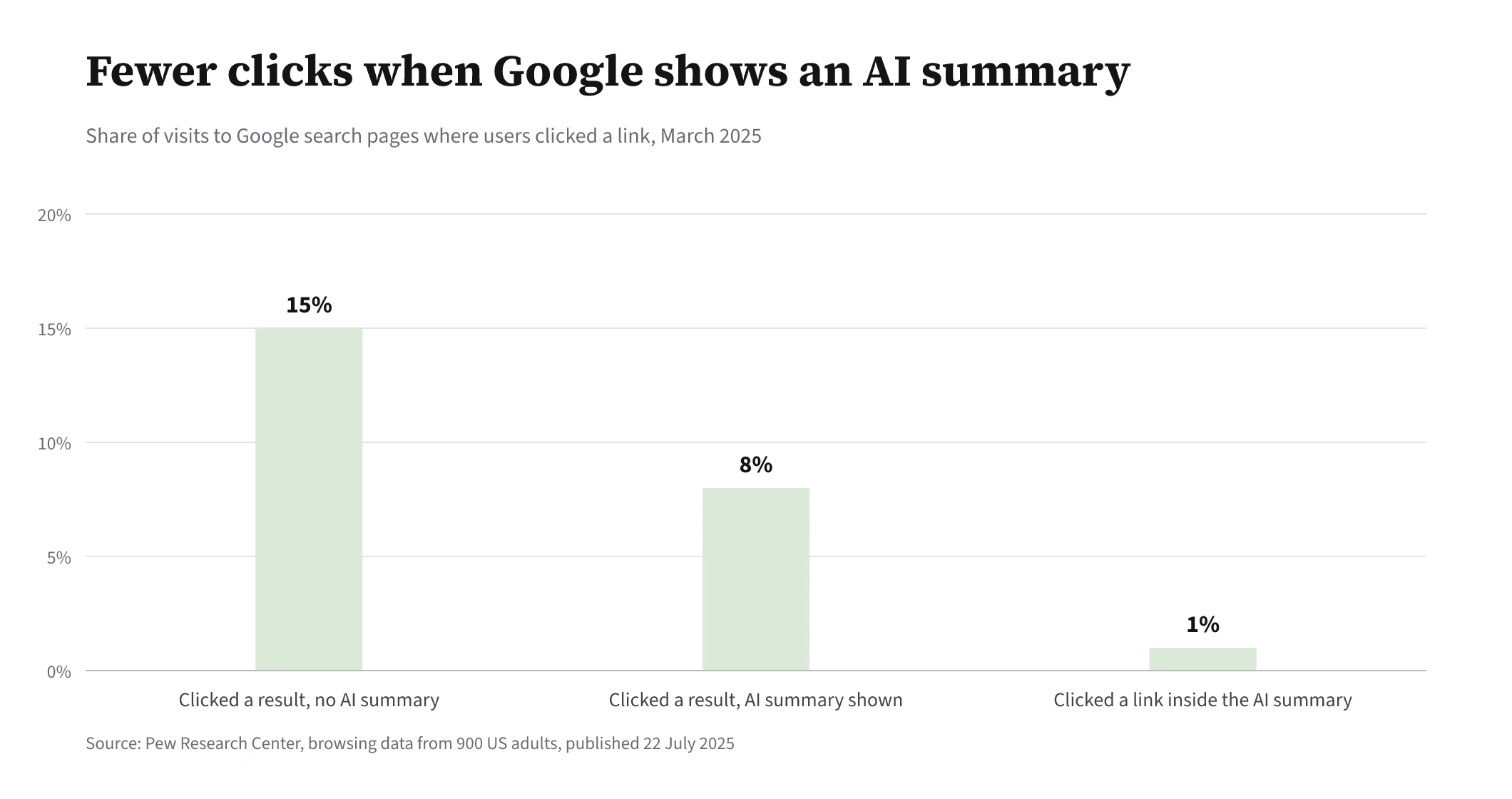
- Pew Research Center found in July 2025 that Google users clicked a traditional result in 8% of visits when an AI summary appeared, against 15% without one.
- Ahrefs found in March 2026 that 37.9% of URLs cited in AI Overviews also appeared in the top 10 results, down from about 76% in July 2025.
- Ahrefs’ May 2025 study of 75,000 brands found branded web mentions had the strongest correlation (0.664) with AI Overview visibility, well ahead of backlinks (0.218).
This article covers what Google has actually said about content since 2024, what AI assistants tend to cite, the types of content that stopped working, and what we would publish if we were starting a content plan this month.
What does Google actually reward in content now?
Google rewards content that gives the reader something they could not get from the ten pages already ranking. That is not our opinion; it is written into Google’s own guidance on helpful, reliable, people-first content.
Read the self-assessment questions on that page and two stand out. One asks whether the content provides “original information, reporting, research, or analysis”. Another asks whether it shows “first-hand expertise and a depth of knowledge”.
The same page asks a blunt question about motive: are you mainly summarising what others have to say without adding much value? Most of the content we audit fails that one.
Google also explains its trust model there. E-E-A-T (experience, expertise, authoritativeness and trust) is not a single ranking factor, but Google says trust is the most important part, and its systems give extra weight to it on topics that affect health, money or safety. If you sell anything expensive or regulated, assume that applies to you.
We have written separately about the evidence and markup that make E-E-A-T visible, if you want the practical side.
What kind of content stopped working?
Content made at volume with nothing new in it stopped working, and Google has said so in plain terms.
In March 2024 Google added a scaled content abuse policy to its spam rules. It covers many pages generated mainly to manipulate rankings rather than help people, “no matter how it’s created”. Generative AI is named as one example, but so are human content farms.
The effect was measurable. Google expected the March 2024 update to cut low-quality, unoriginal content in results by 40%. When the rollout finished, it reported a 45% reduction.
In our audits, the pages that lose out tend to look alike:
- Generic listicles. “Top 10 tips” posts that any competitor could publish word for word.
- Thin location or keyword pages. The same template with a city name swapped in.
- Rewrites of page one. Articles that summarise the current top results without a single fact of their own.
- Trend chasing. Posts on topics the business has no real connection to, written because the keyword had volume.
Is AI-written content itself the problem? No. Google’s position is that the method matters less than the purpose and the result. The trouble is that AI makes the commodity version of an article almost free, so there is far more of it competing for the same few positions. We covered this in more detail in what Google rewards and removes in AI-written content.
| Content type | Still works? | Why |
|---|---|---|
| Original research or survey data | Yes, strongly | Nobody else has it, so it gets cited and linked |
| First-hand case write-ups | Yes | Shows experience Google’s guidance asks for |
| Direct answers to buyer questions | Yes | Matches the sub-questions AI answers are built from |
| Honest comparison tables | Yes | Easy for readers and AI answers to quote |
| Generic "top 10 tips" listicles | Rarely | Commodity content with dozens of near copies |
| Templated city or keyword pages | No | Close to Google’s scaled content abuse examples |
| Summaries of page-one results | No | Adds nothing new, which Google’s guidance warns against |
Does content also decide what AI assistants cite?
Largely, yes, because AI answers in Google are built from pages Google can already find and trust. Google’s documentation on AI features says there are no additional requirements or special optimisations needed to appear in AI Overviews or AI Mode. Normal SEO fundamentals apply.
The same page explains “query fan-out”: the system runs several related searches across subtopics to build one answer. That has a practical consequence. A page can be cited for a question it never ranked for, because it answered one of the sub-questions well.
Ahrefs measured this shift. In July 2025 it found that about 76% of pages cited in AI Overviews also ranked in the top 10. When it re-ran the study in March 2026 on 4 million AI Overview URLs, that figure had dropped to 37.9%. The rest were split almost evenly between positions 11 to 100 and pages outside the top 100.
Our reading: ranking still helps, but a specific, well-structured answer to a narrow question is now worth more than it used to be. That favours depth over breadth.
Google’s own May 2025 advice on AI search says the same thing in fewer words. Focus on “unique, non-commodity content” that people find helpful and satisfying.
Which content formats earn rankings and citations now?
The formats that work share one trait: they contain something the reader cannot find elsewhere. Here is what we see earning visibility for clients, in rough order of payoff.
- Original data. A survey of your customers, prices from your own quotes, failure rates from your own service records. Even a small, honest dataset gets cited because nobody else has it.
- First-hand experience. “We installed 40 of these last year and here is what went wrong” beats any overview. Name the person, the dates and the numbers.
- Direct answers to buyer questions. Cost, timelines, regulations, comparisons. Put the answer in the first two sentences, then explain.
- Clear comparison pages. Honest tables that include where a competitor is the better choice. AI answers often pull from tables.
- Updated cornerstone pages. One maintained guide that gets new figures every year usually beats five thin posts.
A real example from our own case studies: an Australian tiny-house builder built its content around the questions buyers ask before they call, such as cost, council rules and building on a trailer. It went from 2,377 to 4,974 keywords in Google’s top 5 in Australia, and AI answers now link to it as a source 2,755 times.
None of those pages were clever. They were specific.
Is content enough on its own to get cited?
No. Content gets you into the conversation, but what other sites say about you seems to decide how often AI answers mention your brand.
Ahrefs looked at 75,000 brands and their visibility in AI Overviews. The strongest correlation was branded web mentions, at 0.664. Branded anchor text came next at 0.527, then branded search volume at 0.392. The number of backlinks scored just 0.218.
Two cautions. These are correlations, not proof of cause, and Ahrefs says so itself. And brands that get talked about a lot usually also have better content, so the two are hard to separate.
The practical lesson still holds. Content that gets quoted, shared and referenced by other sites does double duty. Original research is the easiest way we know to earn those mentions, which is why it sits at the heart of most good digital PR work.
Is content still worth the investment if AI answers reduce clicks?
Yes, but measure it differently. Clicks from search are falling for many informational queries, and anyone who tells you otherwise has not looked at their Search Console lately.
Pew Research Center tracked the browsing of 900 US adults in March 2025. When a Google search showed an AI summary, users clicked a traditional result in 8% of visits. Without a summary, they clicked in 15%. Links inside the summary were clicked in just 1% of visits.
Google says the clicks that do come from pages with AI Overviews are higher quality, with visitors more likely to spend time on the site. Google has not published figures to back that up, so treat it as a claim rather than a finding.
What this means for your plan: stop judging content only by sessions. Track enquiries, branded searches and how often AI answers mention you. Our post on measuring AI visibility sets out how.
Content that answers a buyer’s question still shapes the decision, even when they never click. The difference is that you now have to earn being the source.
What would we publish if we were starting today?
Fewer pieces, with more in each. If we were planning content for a business from scratch this month, we would start like this.
- List the 20 questions your sales team hears most. Answer each one properly on your site, in the first two sentences of the page.
- Find one dataset only you have. Quotes, job records, support tickets, customer surveys. Publish it once a year.
- Put a real person on every piece. A named author with relevant experience, and examples only they could give.
- Prune before you publish. Merge or remove thin posts that compete with each other. Our guide to auditing a blog section shows how to do it without deleting the wrong pages.
- Update what already works. Refresh figures and dates on your best pages before writing new ones.
Google’s SEO starter guide says there is no magic word count, minimum or maximum. Write until the question is answered, then stop.
Start with an honest look at what you already have. Pick your ten most important pages and ask of each one: what does this page say that nobody else says? If the answer is nothing, that is your first job.
Then add one source of original evidence, even a small one, and build from there. Content is still king. It just has to earn the title now.
If you want a second pair of eyes, SEOValley’s content marketing team can review your existing pages and plan content built around your buyers’ real questions.
About the author
Shabir MS leads SEOValley Solutions and has worked in search since 2005. These days most of his time goes on how brands show up in AI answers, and on separating what the data actually shows from what gets said at conferences. Read more from Shabir MS.
Frequently asked questions
Is AI-generated content penalised by Google?
Not for being AI-generated. Google’s spam policy targets content made at scale mainly to manipulate rankings, however it was produced. AI content that is reviewed, adds original information and helps readers is treated like any other content.
How long should a blog post be for SEO?
Google’s SEO starter guide says there is no magic word count, minimum or maximum. Make it as long as it takes to answer the question fully, and no longer.
How often should we publish new content?
Frequency matters far less than quality. One well-researched piece each month that answers real buyer questions usually does more than weekly posts that repeat what is already ranking.
Do we need special content to appear in Google’s AI Overviews?
Google says no additional requirements or special optimisations are needed. Pages that are indexed, eligible for a snippet and genuinely useful can be cited.
Should we delete old blog posts?
Only after checking them. Posts with traffic, links or enquiries should be updated; thin posts that overlap with others are usually better merged or redirected than left to compete.