+91 9893014167
  1 (888) 316-3286
 +44 20 3807 2189
 Chat on WhatsApp
Last updated: 23 September 2026
You rank third for a question your business has owned for two years. The AI summary above your result cites four sources, and none of them is you. One of the four does not appear anywhere on the first page.
Search Console offers no explanation, because it has no dimension for any of this. Pick the wrong theory and a quarter disappears into rewriting pages that were never the problem.
The short answer: Google’s AI Overviews cite pages that answer the sub-questions behind your query, not only the pages ranking for the query itself. Ahrefs found 37.1% of cited URLs also rank in the top ten, while 36.7% rank nowhere in the top 100. What gets picked then depends on intent: articles for informational questions, listicles for commercial ones, product pages for transactional.
Key facts
- Ahrefs analysed 863,000 keyword SERPs and four million AI Overview URLs in March 2026: 37.1% of cited pages also ranked in the top ten for the same query, while 36.7% did not rank in the top 100 at all.
- The same research put that top-ten figure at roughly 76% in July 2025, across a smaller sample of 1.9 million citations.
- BrightEdge, tracking nine industries from May 2024 to September 2025, measured overlap moving the other way — 32.3% to 54.5%, with healthcare at 75.3% and restaurants at 19.2%.
- Wix Studio AI Search Lab examined 1,056,727 citations across 75,000 AI answers in March 2026: listicles took 21.9% of citations, articles 16.7% and product pages 13.7%, and query intent predicted content type better than either industry or model.
- Pew Research Center, studying 68,879 Google searches by 900 US adults in March 2025, found 18% returned an AI summary, rising to 53% for queries of ten words or more; Wikipedia, YouTube and Reddit supplied 15% of the sources those summaries linked to.
- Among AI Overview citations that did not rank in Google’s top 100, Ahrefs found 18.2% were YouTube URLs, and YouTube accounted for 5.6% of all cited URLs in the dataset.
- Google’s documentation states that “there are no additional requirements to appear in AI Overviews or AI Mode, nor other special optimizations necessary”.
What follows is a read of the published citation research: who measured what, where studies contradict each other, and what each finding changes about what you publish.
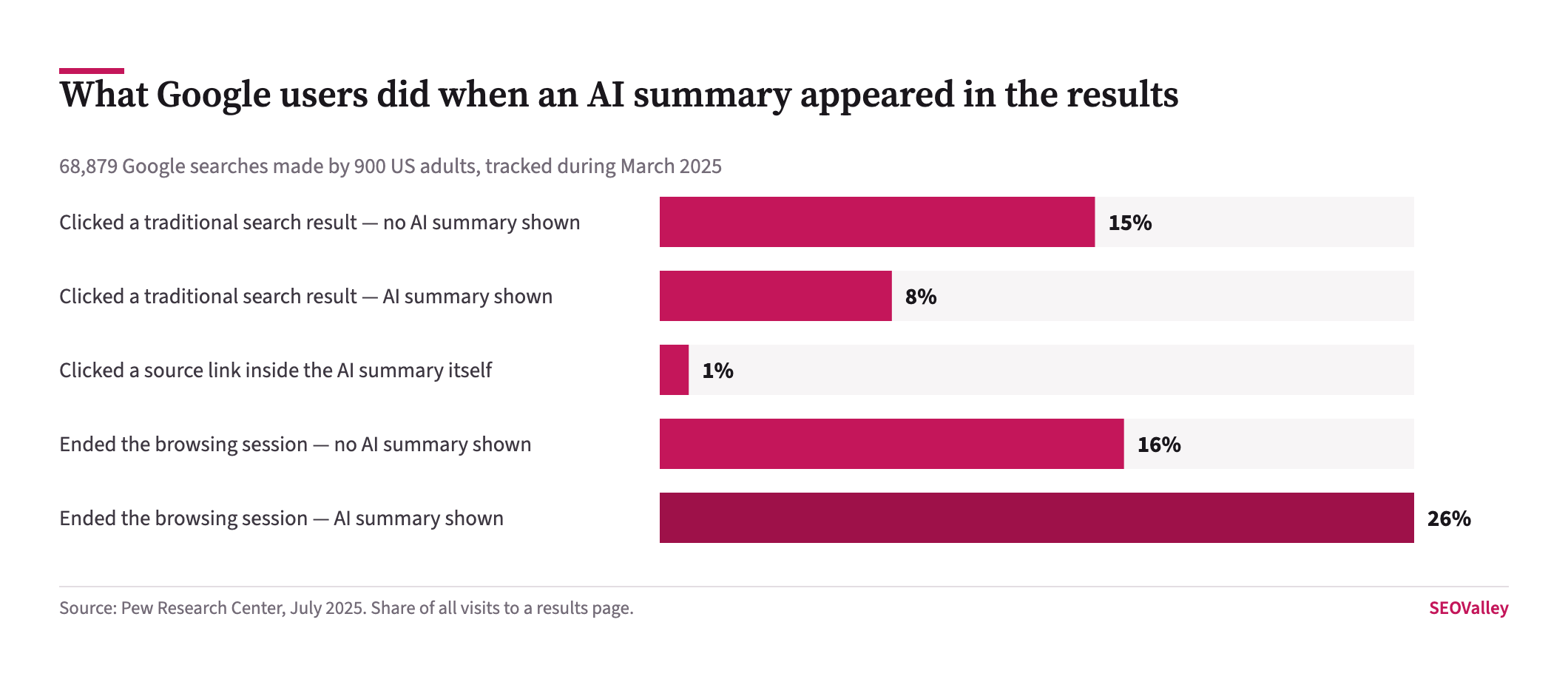
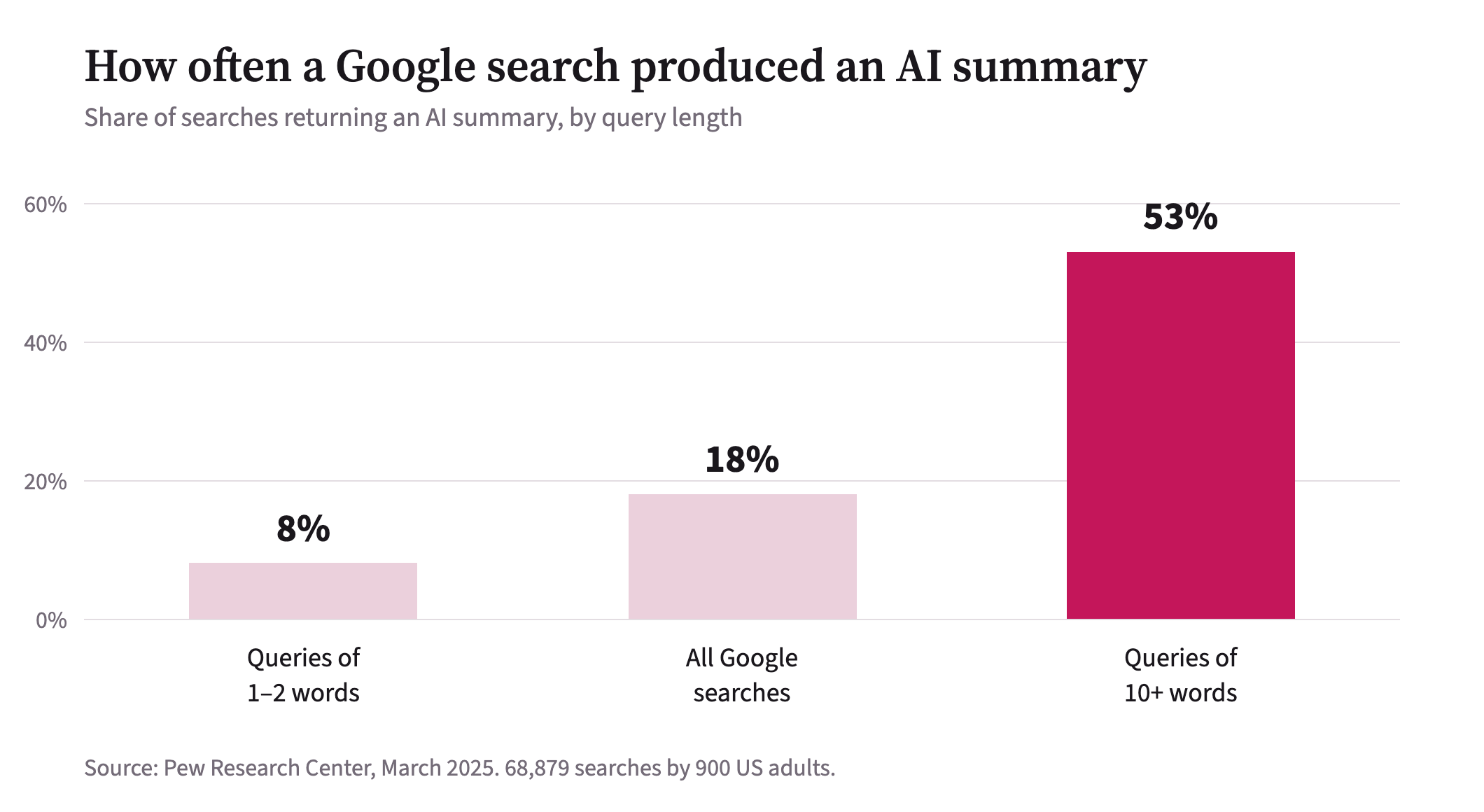
Scope first. Pew Research Center found 18% of Google searches produced an AI summary in March 2025, rising to 53% for queries of ten words or more and 60% for searches beginning with a question word. Once one appeared, a traditional result was clicked on 8% of visits against 15% without one, and links inside the summary on 1% — a split we covered in the ten reasons rankings hold while clicks fall.
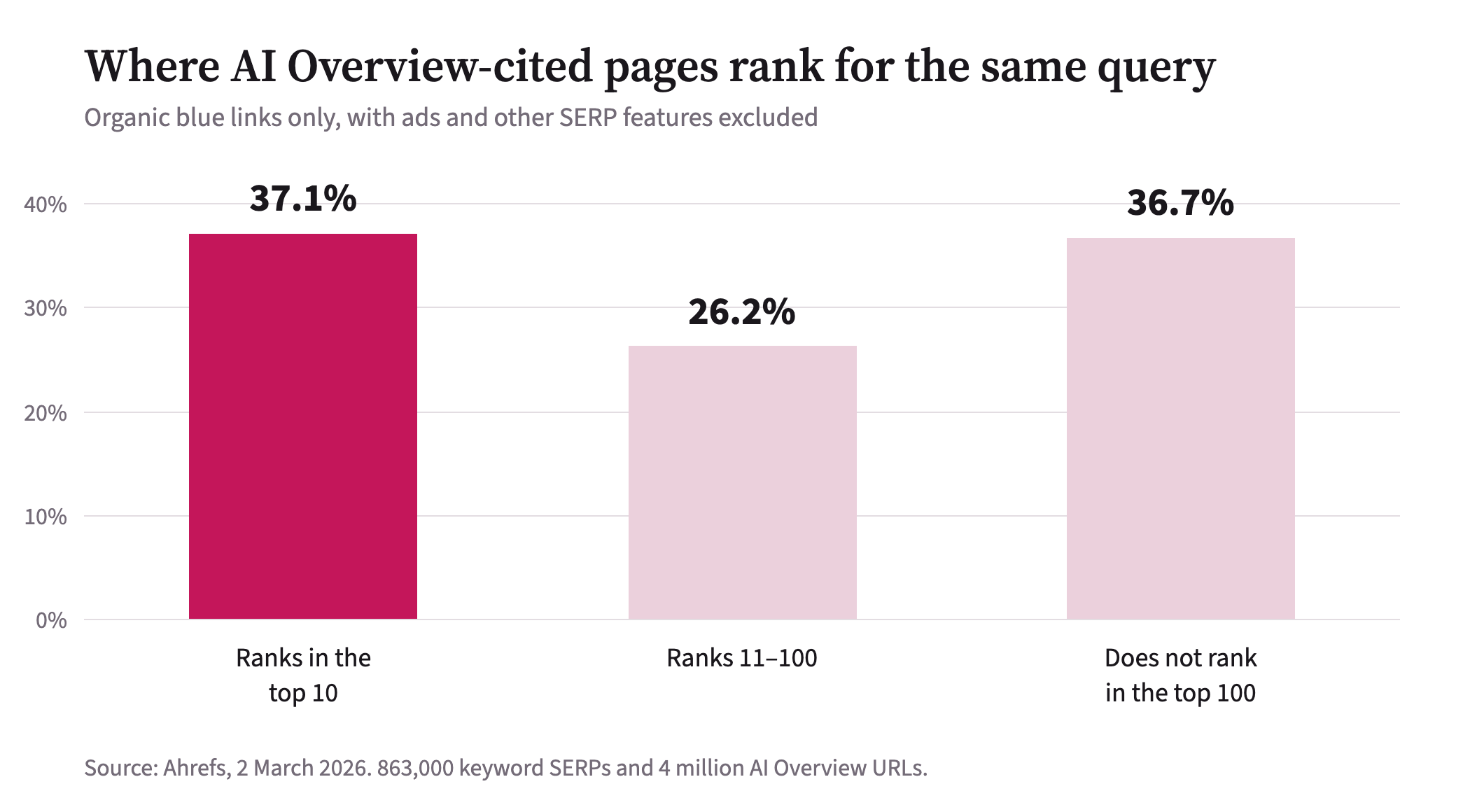
Do AI Overview citations still come from the top ten results?
What it looks like: your page holds a strong position, the summary above it names four other sites, and one of them you have never heard of.
Key data: Ahrefs, publishing on 2 March 2026, analysed 863,000 keyword SERPs and four million AI Overview URLs. Counting organic blue links only, 37.1% of cited URLs also ranked in the top ten for the same query, 26.2% ranked between 11 and 100, and 36.7% did not rank in the top 100.
Why it matters: ranking work buys you roughly a one-in-three chance of being the source. It is no longer the mechanism that decides it.
Here is the check. Take twenty queries where you rank in the top five, search each logged out on mobile, and record the query, every domain cited, the URL cited, and that URL’s own position below. Forty minutes gives you a hit rate no study can.
Google documents the mechanism. Its guidance on AI features in Search describes a query fan-out — multiple related searches across subtopics and data sources — which is why the links shown are wider than the ten blue ones. Ahrefs reads its own drop from 76% to 38% the same way: with Gemini 3 powering AI Overviews since January 2026, pages that win the sub-query results get cited for the parent question.
A second study points the other way, and the disagreement is worth understanding. BrightEdge, monitoring nine industries between May 2024 and September 2025, recorded citation-to-organic overlap rising from 32.3% to 54.5% — reaching 75.3% in healthcare and 19.2% in restaurants. The two differ on measurement unit, sample, window and sector mix, and any one of those opens a gap this wide. A spread of 56 percentage points between sectors also means the average describes almost nobody, which is the argument for measuring your own.
Which sites get cited most often?
What it looks like: the same few very large platforms appear in summary after summary, whatever you search for.
Key data: Pew Research Center found Wikipedia, YouTube and Reddit together accounted for 15% of the sources Google’s AI summaries linked to, against 17% of standard results — so the concentration mirrors ordinary search rather than exceeding it. Government sites were the exception, appearing in 6% of AI summaries against 2% of standard results. Ahrefs reports YouTube as the single most-cited domain in AI Overviews, up 34% over six months.
Why it matters: a share of every summary is spoken for before your page is considered, and the sites holding it are not sites you can outrank.
Count it from your own sample. Split the cited domains three ways: platforms you can publish on, competitors you can outrank, institutions you cannot displace. The ratio tells you where effort belongs, and it differs enormously by topic.
The unwelcome part follows. For some questions the highest-return move is a well-argued Reddit answer or a five-minute video, not another post on your own domain, and most agencies are reluctant to say so because neither is billable in the usual way. Our guidance on running a YouTube SEO campaign now does double duty as citation work.
Does query intent change what gets cited?
What it looks like: the same site is cited constantly for how-to questions and never for buying questions, or the reverse.
Key data: Wix Studio AI Search Lab analysed 1,056,727 citations across 75,000 AI answers from ChatGPT, Google AI Mode and Perplexity, published 23 March 2026. Listicles took 21.9% of all citations, articles 16.7% and product pages 13.7% — more than half between the three. Comparison and alternative pages together took under 3%. Intent predicted content type more strongly than either industry or model.
Why it matters: publishing the wrong format for the intent is not a small inefficiency. On some intents the format you chose takes under 4% of citations.
Classify the twenty queries in your sample by intent — informational, commercial, transactional, navigational — then note what kind of page each cited URL actually is. Patterns show up fast, and they are usually uncomfortable for whoever signed off the content plan.
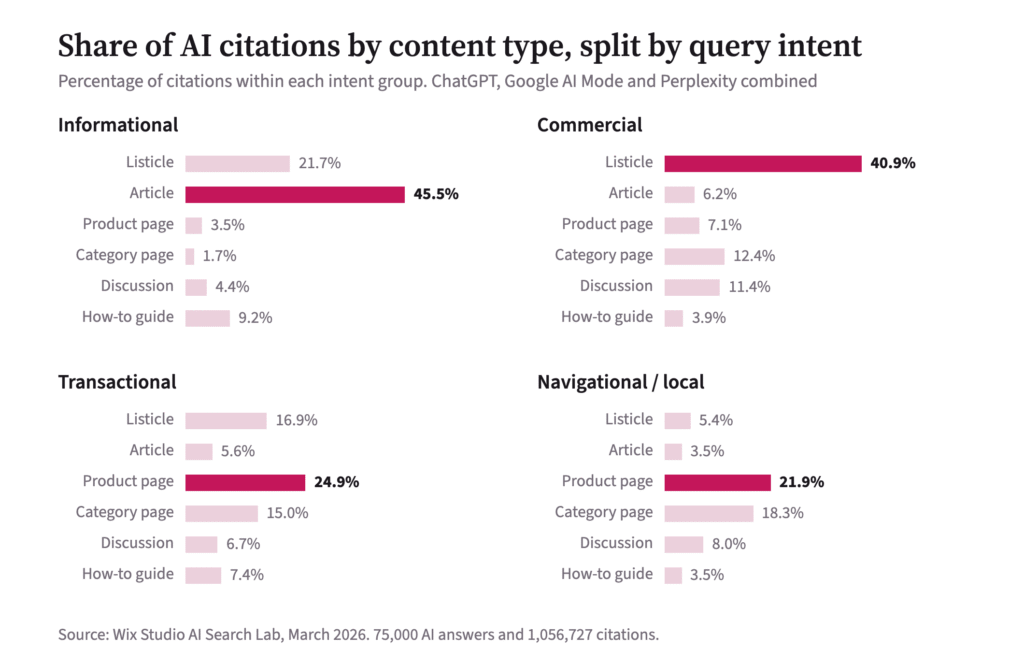
What gets cited when someone is trying to understand something?
What it looks like: long-form explanatory writing wins the citations, and everything commercial on your site is invisible.
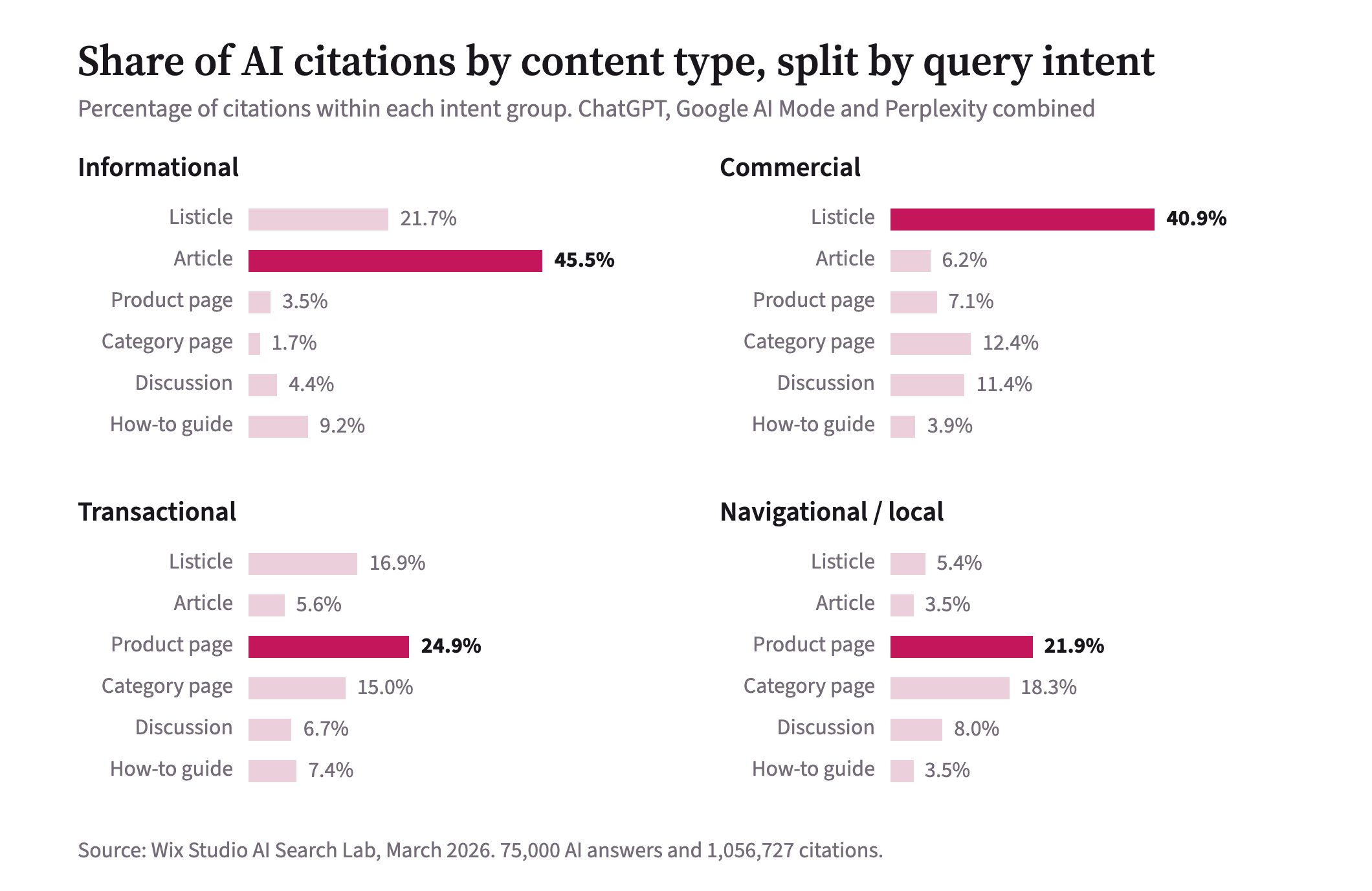
Key data: on informational prompts, articles took 45.48% of citations in the Wix Studio dataset — 172.7% above their overall average. Listicles took 21.68% and how-to guides 9.21%. Product pages managed 3.45%, category pages 1.74% and homepages 0.42%.
Why it matters: a homepage cited on 0.42% of informational answers will never carry your expertise into one, however well it converts.
Filter Search Console’s query report to the question words your audience uses — how, what, why, best way to — and check which URLs rank for them. If the answer is your service pages, your informational coverage is a gap rather than a strategy.
Two qualifications matter. This measures what gets cited, not what earns revenue, and informational citations are the ones Pew showed produce the fewest clicks. A serious editorial programme for a blog earns its place through presence in answers, not sessions, and should be budgeted that way.
What gets cited when someone is comparing options?
What it looks like: third-party roundups dominate the answer, and your detailed product page is nowhere in it.
Key data: on commercial prompts, listicles took 40.86% of citations — 86.7% above their average and nearly double their share on any other intent. Category pages took 12.42% and discussions 11.44%, while articles fell to 6.15% and product pages to 7.14%.
Why it matters: the page you are most likely to have built for “best X” is the page least likely to be selected.
Search your top ten commercial queries, list the cited URLs, then check who publishes them. In professional services, where listicle citation runs highest, Wix Studio examined the 1,000 most-cited URLs and found 19.1% were self-promotional against 80.9% published by neutral third parties.
That four-to-one split is the whole strategy for commercial intent, and most of it sits outside your content calendar. Appearing in other people’s roundups is outreach work: pitching review editors, answering journalist requests, keeping your entry in comparison sites and G2-style directories current. A “top ten tools” post with your own product at number one is not a substitute.
What gets cited when someone is ready to buy, or searching locally?
What it looks like: the summary links straight to shop pages and listings, and your blog does not feature at all.
Key data: on transactional prompts, product pages took 24.88% of citations and category pages 14.97%, while articles fell to 5.58%. On navigational and local prompts, product pages took 21.95%, category pages 18.31%, homepages 13.56% and profile pages 12.89% — the only intent where a homepage performs at all.
Why it matters: for a retailer or local service business, citation work is template work on pages that already exist, not a publishing programme.
Crawl your product and category templates in Screaming Frog and check three things: whether specification, price and availability appear as text in the HTML rather than injected by JavaScript; whether Product, Offer and LocalBusiness markup validates; and whether the page says in a sentence what it is and who it serves. Anything failing all three gives a model nothing to quote.
Structured data is the part people get backwards. It does not persuade a system to cite you, and Google is explicit that no separate ranking system exists for AI features. It removes ambiguity about what a page is, which counts for more when the entity is unfamiliar. The entity consistency Google looks for matters more now than when schema was only about stars in a snippet.
Does it matter which assistant you are optimising for?
What it looks like: you are cited well in one assistant and absent from another, with the same pages.
Key data: ChatGPT showed the heaviest article preference in the Wix Studio data and the lowest use of discussions. Google AI Mode represented all eleven content types with the least bias. Perplexity drew 17.35% of citations from discussion pages against a 7.52% average. Semrush’s 2026 AI Visibility Index, covering 126 million US prompts between January and April 2026, found ChatGPT averaged 15 sources per response while Gemini averaged three.
Why it matters: a platform citing three sources is a platform where second place is invisible, which changes what a near-miss is worth.
Track it rather than assuming it. Run your twenty priority questions through ChatGPT, Gemini, Perplexity and Google’s AI Overviews once a month, and log whether you were cited and what was said about you. Half an hour a month, and it is the only visibility data that matches how a growing share of people search.
Model differences are real and smaller than the intent effect. Building separate content for separate assistants spends a budget without moving anything. Our piece on what AI SEO involves and how to measure it covers the tracking side.
Why does YouTube get cited on queries where it does not rank?
What it looks like: a video appears as a source in the summary and cannot be found anywhere in the results below.
Key data: among AI Overview citations that did not rank in Google’s top 100 for the query, Ahrefs found 18.2% were YouTube URLs, making up 5.6% of every cited URL in the four-million-URL dataset. In a separate study of 75,000 brands, Ahrefs reported that mentions on YouTube — in titles, transcripts and descriptions — were the strongest correlating factor with AI Overview visibility it measured.
Why it matters: a channel returning almost nothing in your analytics may be doing more for your search visibility than the pages you report on every month.
Check whether your brand is spoken about there at all. Search your brand name and three main product terms on YouTube, then repeat with “review” and “vs” appended, and note who is talking. Transcripts are indexed text, so a mention inside a video is a mention on the open web.
Correlation is not causation, and Ahrefs sells a tool for tracking precisely this — both reasons to treat that finding as a signal rather than a mechanism. The rank-level number is harder to argue with: a page cited for a query it does not rank for was reached some other way.
Does publishing something newer get you cited?
What it looks like: a competitor republishes an old post with a fresh date and starts appearing in answers.
Key data: Ahrefs analysed 16.975 million cited URLs in July 2025 and measured the average age of cited pages by platform. ChatGPT citations averaged 958 days old, Copilot 1,056, Gemini 1,118 and Perplexity 1,166. Google AI Overviews averaged 1,432 days — against 1,416 days for ordinary Google organic results.
Why it matters: for AI Overviews specifically, freshness has close to no measurable effect, and a republishing programme sold on that basis is selling something the data does not support.
Record the publication date of every cited URL in your sample. If the median runs to years, the gap between you and the cited page is not recency.
The finding splits by platform, which is where the nuance sits. A 474-day gap between ChatGPT and AI Overviews justifies different treatment of the same page: worth refreshing if assistants matter to you, worth little if Google’s summary is the target. Refurbishing older content still earns its keep for ordinary rankings, which is the honest reason to do it.
What can you actually control here?
What it looks like: a long list of proposed AI SEO tactics, most of which nobody can show works.
Key data: Google’s documentation sets one technical bar — a page “must be indexed and eligible to be shown in Google Search with a snippet, fulfilling the Search technical requirements” — and states that no additional requirements or special optimisations exist. The controls available are the existing preview directives: nosnippet, data-nosnippet, max-snippet and noindex.
Why it matters: the eligibility rules are short and public, so most of what is sold as AI-search optimisation is either ordinary SEO renamed or unevidenced.
Audit your own exposure first. Crawl the site, list every page carrying nosnippet or a restrictive max-snippet value, and check whether anybody intended them. We have found sites excluded from their own answers by a directive added years earlier to block a scraper.
On llms.txt the position is worth stating plainly. Speaking on Google’s Search Off the Record podcast in June 2026, John Mueller argued the format cannot help a model choose between sites, because the file is self-reported: a system “can’t trust what is here as a way of differentiating between different websites”. Adding one costs almost nothing, and so does the benefit. Time spent on first-hand evidence and treating E-E-A-T as an engineering problem has better odds.
Matching what you are seeing to what is causing it
| What you observe | Most likely cause | Confirm it with |
|---|---|---|
| You rank first and are never cited | Fan-out sub-queries won by other pages | Twenty-query sample: record each cited URL’s own rank |
| Cited sources rank nowhere on page one | Normal behaviour — 36.7% of citations rank outside the top 100 | Ahrefs rank-distribution benchmark, March 2026 |
| Guides get cited, commercial pages never do | Intent mismatch: articles take 45.5% of informational citations, 6.2% of commercial | Classify sample queries by intent, then note the page type cited |
| Third-party roundups win every buying query | Commercial intent favours listicles, four-fifths of them third-party | List the publishers of cited URLs on ten commercial queries |
| A video is cited that is not in the results | YouTube reached via fan-out — 18.2% of non-ranking citations | Search the query on YouTube; check transcripts for brand mentions |
| A page is absent from every answer it belongs in | Snippet suppression or an indexing fault, not a content problem | Crawl for nosnippet, data-nosnippet, max-snippet and noindex |
Where to start if you only do one thing
Citations follow the sub-questions, not the headline query, and the format that wins them changes completely with what the searcher is trying to do. Ranking well makes you a candidate. It settles roughly a third of the outcome; the rest happens somewhere you cannot currently see.
The single next action is the twenty-query sample. Pick your twenty highest-value questions, run them logged out, and record the cited domain, the cited URL, that URL’s rank, the page type and its publication date. It takes an afternoon and replaces every average in this article with numbers about your own market.
What not to do: do not buy a retainer whose deliverable is an llms.txt file and a citation count with no baseline. Do not rewrite service pages into blog posts because articles win informational citations — that trades a converting page for a cited one. And do not report citations as sessions, because Pew’s figure for clicks inside a summary is 1%, and someone with a budget will notice the gap.
If you would like the sample run for you, our SEO audit covers the ranking and indexing side of why pages are or are not eligible, and our AI SEO service covers citation tracking and the off-site work that follows.
Written by Shabir MS, who has run search campaigns at SEOValley for over two decades and spends most of his week inside client Search Console and GA4 properties working out why a number moved. The checks above are the ones our audit team runs before anyone proposes a content plan. Where a claim comes from published research, the organisation, sample size and date are named so you can go and read it.
Frequently asked questions
How many AI Overview citations come from the top ten results?
Ahrefs found 37.1% of cited URLs also ranked in the top ten organic results in March 2026, across 863,000 keyword SERPs. A further 36.7% did not rank in the top 100 at all.
Why did that figure fall from 76% to 38%?
Ahrefs attributes the drop to query fan-out expanding more aggressively since Gemini 3 began powering AI Overviews in January 2026. Sources are increasingly drawn from sub-query results rather than the original results page.
Which content type gets cited most overall?
Listicles, at 21.9% of citations in the Wix Studio AI Search Lab study of 1,056,727 citations. Articles took 16.7% and product pages 13.7%, making up more than half between the three formats.
What gets cited for informational queries?
Articles dominate at 45.48% of informational citations, with listicles at 21.68% and how-to guides at 9.21%. Product pages take 3.45%, category pages 1.74% and homepages just 0.42%.
What gets cited for commercial queries?
Listicles take 40.86% of commercial citations, nearly double their share on any other intent. Category pages follow at 12.42% and discussion pages at 11.44%, while articles fall to 6.15%.
Should I publish my own “best tools” listicle?
In professional services, Wix Studio found 80.9% of cited listicles came from neutral third parties and only 19.1% were self-promotional. Getting into other people’s roundups outperforms writing your own.
Do different AI assistants cite different things?
Yes, but less than intent does. Perplexity draws 17.35% of citations from discussion pages against a 7.52% average, ChatGPT favours articles, and Google AI Mode is the most evenly spread.
Why is YouTube cited for queries it does not rank for?
Query fan-out pulls sources from related sub-query results. Ahrefs found 18.2% of citations that did not rank in Google’s top 100 were YouTube URLs, and 5.6% of all cited URLs.
Does refreshing old content help you get cited?
Barely, for AI Overviews. Ahrefs measured cited pages there averaging 1,432 days old against 1,416 for organic results. ChatGPT is different, averaging 958 days.
Is llms.txt worth adding?
John Mueller said on Google’s Search Off the Record podcast in June 2026 that the file is self-reported, so systems cannot trust it to differentiate between websites. The cost is small and so is the benefit.