+91 9893014167
 1 (888) 316-3286
 +44 20 3807 2189
 Chat on WhatsApp



If you run an online business, your inbox has probably filled up this month with guides telling you to claim your business in ChatGPT before a competitor does. OpenAI’s Business Hub went live on 10 November, and the rush is on.
Here’s the short answer. Claiming your profile won’t, on its own, get you recommended more often, and OpenAI’s own help page says so. Claim it anyway for accurate facts and first-party click data, then put your real effort into what does drive recommendations: pages that answer buyers’ exact questions, and a brand the model already knows.
Part of our AI Search Guides: plain-English guides to how Google's AI and ChatGPT pick websites.
Key Facts
- OpenAI launched Businesses in ChatGPT in beta on 10 November 2026, letting businesses claim a profile, update details and add product feeds, and said ChatGPT has 1.2 billion weekly users.
- OpenAI’s help article Setting up your business on ChatGPT, accessed 22 November 2026, states that claiming a profile doesn’t change its visibility in ChatGPT.
- The same OpenAI help article says a mention of an online business counts only when ChatGPT references its website, and the brand name alone doesn’t count.
- A University of Toronto preprint posted in October 2026 found that 46% of ChatGPT’s mentions of a brand the question didn’t name had no cited page naming that brand.
- The same Toronto study found that which pages ChatGPT’s own search retrieved explained 32% of citation differences between pages on one website, while page properties explained 2.8%.
- OpenAI said on 10 November 2026 that Business Agents are available only to eligible ecommerce and online-service businesses in the US.
- Search Engine Roundtable first reported the tool on 6 November 2026 and noted it shows no prompt data, user data or competitor benchmarks.
Below I cover what Business Hub does, what OpenAI says it won’t do, what a large University of Toronto study found actually gets brands named, why the new dashboard may undercount your mentions, who can claim, and what we’d do this week.
What Is Businesses In ChatGPT, And What Does Business Hub Let You Do?
It’s OpenAI’s first official way for a business to manage how it appears inside ChatGPT. OpenAI launched Businesses in ChatGPT in beta on 10 November 2026, pointing out that ChatGPT now has 1.2 billion weekly users.
Through Business Hub you can:
- claim and verify your profile
- update key details once verified
- add product feeds with pricing and availability
- see insights: mentions, website clicks and “discovery topics”, the common themes across conversations where your website is cited
US ecommerce and online-service businesses can also build a Business Agent, and can pay to sponsor it as the landing spot for ChatGPT Ads.
The launch wasn’t a total surprise. Search Engine Roundtable reported the tool on 6 November, after Juozas Kaziukėnas spotted early versions dating back to August. Barry Schwartz’s follow-up on 10 November confirmed it had gone live with click data.
Insights are aggregated, cover the past 28 days and only appear once enough conversations meet OpenAI’s thresholds. OpenAI says it doesn’t share users’ conversations or agent chats with businesses.
Does Claiming Your Profile Make ChatGPT Recommend You More?
No, and OpenAI says so in plain words. Its help article Setting up your business on ChatGPT (accessed 22 November 2026) states: “Claiming a profile or disputing ownership doesn’t change its visibility in ChatGPT.”
The same page says connecting a product feed doesn’t publish an agent, and it doesn’t promise ChatGPT will recommend your products either.
The paid side sits in its own lane. OpenAI describes agent conversations as “clearly labeled… and distinct from ChatGPT’s independent answers”. Sponsoring an agent buys you a labelled ad destination, not a seat in the normal answer.
I find that refreshingly honest. Most of the “claim it now” guides published since launch skip straight past it, and owners are reading them as a ranking trick. It isn’t one.
Why it matters: if you claim your profile and wait for recommendations to climb, you’ll be disappointed. The profile fixes facts. Something else decides whether you get named.
| Business Hub feature | Who can use it | What it won’t do |
|---|---|---|
| Claimed profile | Any eligible business where ChatGPT is available; local stores and restaurants only via an existing US listing | Change your visibility in ChatGPT, per OpenAI |
| Product feeds | Businesses that have claimed and verified a profile | Publish an agent or promise that ChatGPT recommends your products |
| Insights (mentions, clicks, discovery topics) | Verified owners after Persona approval, once thresholds are met | Count brand-name-only mentions of online businesses, or show prompts or competitors |
| Business Agent | Eligible US ecommerce and online-service businesses | Appear inside ChatGPT’s independent answers; agent chats are labelled and separate |
| Sponsored agent for ChatGPT Ads | Businesses with a Business Agent | Buy a place in ChatGPT’s normal recommendations |
What Actually Gets A Business Named In ChatGPT Answers?
Two things, going by the best evidence published so far: being found by the searches ChatGPT writes for itself, and being a brand the model already remembers.
That evidence is a University of Toronto preprint by Mahe Chen and Nick Koudas, posted in October 2026. It tracked 158,099 answers with 468,037 citations across two 90-day collections of commercial questions.
Key data: for ChatGPT, which pages its own search retrieved explained 32% of the differences in citations between pages on the same website. Page properties explained 2.8%. Brand memory carried real weight too: a brand the model already knew was named at 5.8 times the odds, with equal citation support. In a controlled test, the same product description reached ChatGPT’s top three in 80% of answers under one brand name and 39% under another.
The authors put it neatly: “Pages are thus cited when searched; brands are also named when remembered.”
Two more findings surprised me. 97% of the pages ChatGPT retrieved weren’t in Google’s top 50, and 99% weren’t in Bing’s top 30. Yet 51% of them came from websites that do appear in Google’s top 50. Strong sites get cited, often through pages that don’t rank. Answers also churn fast: two weeks later only 40% of ChatGPT’s pattern was still shared, and ten weeks later just 14%.
Be clear on the limits. The study queried the engines through developer APIs (GPT-5.4 nano with web search, Gemini 3.1 Flash Lite, Perplexity Sonar), not the consumer apps. It covered one US consumer market, home internet, plus a small market of B2B software vendors. And the results are associations, not proof of cause.
Our own results point the same way. For a UK car lighting retailer’s SEO and AI search case study, the headline is 33% more organic visits and AI answers now linking to it 1,956 times. On 10 November 2026 the live page counted 1,875 of those links from Google AI Overviews, 41 from ChatGPT and 40 from Google AI Mode. In a ChatGPT screenshot taken on 13 November 2026, it was the first UK supplier suggested for HID ballasts.
The lesson: the work included monthly articles answering bulb and fitting questions, exactly the kind of question-matching content the Toronto study found matters. No profile claim was involved, because Business Hub didn’t exist yet.
The honest footnote is that ChatGPT is a small slice of this retailer’s AI links, 41 out of 1,956. And as a UK business it can claim a profile but can’t run a Business Agent, because agents are US-only.
Are FAQ Blocks, Schema And Author Boxes Still Worth Adding?
Add them if they help your readers, but the Toronto data says they won’t win ChatGPT citations on their own.
Compared across different websites, the usual GEO page features looked like winners: FAQ block +18.1%, summary box +20.9%, author box +14.9%, schema markup +7.5% and faster page speed +11.7%. Compare pages on the same website, though, and none of them was significant.
What held up was relevance. Pages whose titles matched a buyer’s question saw +14.1%, and pages with the best-matching paragraph saw +15.5%.
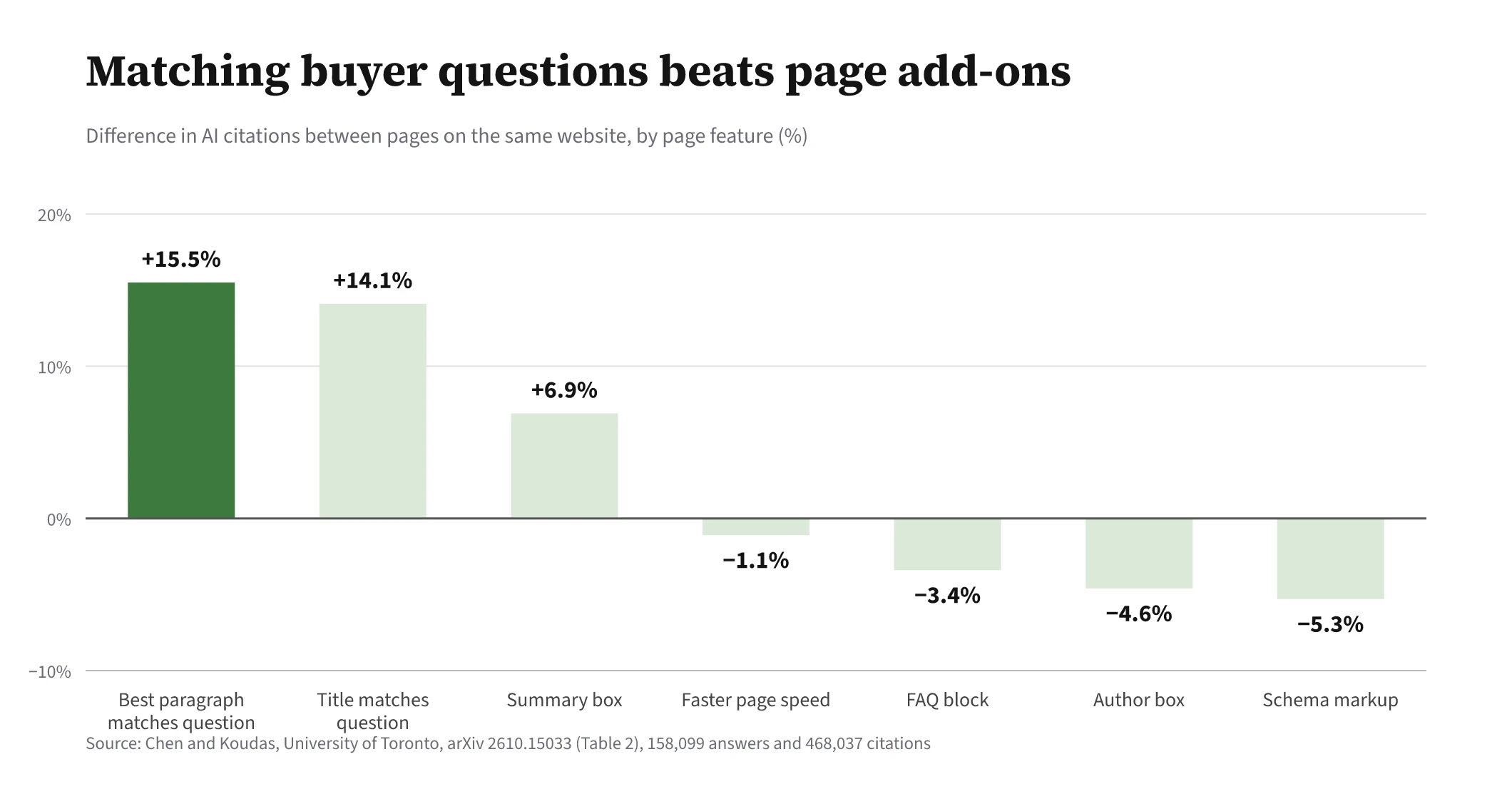
My reading, and it’s opinion: the across-website gains mostly reflect that stronger, better-run sites tend to have these features anyway. Copy the features and you don’t copy the strength.
Why it matters: if your plan for AI visibility is a schema plugin and an FAQ accordion, you’re working on the 2.8% and ignoring the 32%. Start from the questions buyers actually ask and make sure a specific page answers each one in its title and opening paragraphs.
Will Business Hub Show You Every Time ChatGPT Names You?
Probably not, and this is the part of the launch I’d question hardest.
What it looks like: according to OpenAI’s help article, a mention of an online business counts only when ChatGPT references the business’s website. “The brand name alone doesn’t count.” For a local business, a mention counts when ChatGPT shows a result for that location.
Key data: the Toronto study found that 46% of ChatGPT’s mentions of a brand the question didn’t name had no cited page naming that brand.
Put those side by side and you get our inference, not a measured fact. When ChatGPT names you from memory without pointing to your site, Business Hub may never count it. If anything like the study’s 46% holds in the consumer app, the dashboard could miss a large share of the times ChatGPT recommends you by name. The study used API models, so treat this as a hypothesis to test against your own data. OpenAI also notes that a blank metric doesn’t necessarily mean zero activity.
We see the same gap in our reporting. For an Australian tiny house builder’s AI search case study, links to the site inside AI answers came to 2,868, while times AI answers named the brand came to 1,075. Two different numbers measuring two different things. Business Hub’s definition for online businesses sits much closer to the first.
There’s no competitor view either. Search Engine Roundtable found no prompt data, no user data and no competitor benchmark or ranking. You’ll still need independent tracking to see who ChatGPT recommends instead of you, which we covered in how to measure AI visibility when there’s no rank to track.
Why it matters: the click numbers are genuinely new and useful, especially once you line them up with GA4 sessions and conversions. If you need help joining those sources, that’s what our analytics services cover. Just don’t read the mention count as the full picture.
Who Can Claim, And what’s The Catch Outside The US Or For Local Shops?
Any eligible business located where ChatGPT is available can claim, but local shops outside the US are mostly stuck for now.
The details, from OpenAI’s setup guide:
- You verify by business phone, business email, a DNS TXT record on your domain, or Shopify.
- You then need Persona identity verification before you can publish changes or see insights. The blue check appears only after Persona approves you.
- Local stores and restaurants can currently claim only an existing US listing.
- You don’t need an Ads account or an Enterprise agreement.
- Support can’t delete or unpublish a published profile, so get the details right first time.
There’s one pleasant surprise for online sellers. Search Engine Journal’s Vahan Petrosyan notes that Business Hub accepts online-only businesses, which Google Business Profile lists as ineligible. When he tried to create a new business with a physical location, he got a waitlist.
Business Agents are narrower still: eligible US ecommerce and online-service businesses only. Our US golf components supplier case study, where AI answers now link to its site as a source 1,238 times, is exactly the kind of business that could build one. The UK car lighting retailer above can’t.
So Should You Claim Your Business In ChatGPT This Week?
Yes. Claim it this week, and expect nothing from it in terms of recommendations.
The case for claiming is simple:
- It’s free to start, with no ads account needed.
- It puts correct facts and product feeds in front of ChatGPT.
- It gives you ChatGPT’s own click numbers for the first time.
If you sell online, keep your feed’s prices and stock accurate, the same discipline that matters for ecommerce SEO generally. A stale feed is worse than none.
What I wouldn’t do is pay to sponsor an agent in the hope it lifts your organic presence. OpenAI is explicit that agent conversations sit apart from ChatGPT’s independent answers.
At SEOValley, the fundamentals we’d prioritise haven’t changed with this launch: pages that answer buyers’ exact questions, and a brand that other sites mention and link to. If you want to know whether gains in ChatGPT carry over elsewhere, our post on ChatGPT visibility and other AI engines covers that.
Claim your profile this week, verify it properly and fill in every detail, because support can’t unpublish it once it’s live. Connect your feed if you sell online. Then stop expecting the profile to do the heavy lifting.
Spend the next quarter on the two things the evidence points to: pages that answer the exact questions your buyers ask, and mentions of your brand on other sites. Watch Business Hub’s click numbers alongside your own tracking, and see how other businesses have fared on our case studies page. If you want an outside view of where you stand in AI answers, that’s what our AI SEO services are for.
AI Powered Digital Growth, since 2000
If this is happening to your traffic, talk to us. We’ll look at your site, your searches and your AI visibility, and tell you plainly what’s worth doing.
Frequently Asked Questions
Is claiming free, and can I do it outside the US or as a local shop?
It's free to start: you don't need an Ads account or an Enterprise agreement, and any eligible business located where ChatGPT is available can claim. Local stores and restaurants can currently claim only an existing US listing, so a UK high-street shop may have to wait.
Will a Business Agent or a sponsored agent get me into ChatGPT's normal answers?
No. OpenAI says agent conversations are clearly labelled and distinct from ChatGPT's independent answers, and sponsoring an agent makes it a destination for ChatGPT Ads. Agents are also limited to eligible US ecommerce and online-service businesses.
Does Business Hub replace AI visibility tracking tools?
No. It shows your own mentions, clicks and discovery topics, but Search Engine Roundtable found no prompt data, user data, competitor benchmark or ranking. You still need independent tracking to see who ChatGPT recommends instead of you.
ChatGPT says something wrong about my business. Will updating my profile fix it?
Updating your verified details puts correct facts in front of ChatGPT, but OpenAI hasn't said how quickly answers change. Since the Toronto study found brands are often named from memory, also correct the facts on your own site and wherever else you're mentioned.
Should I still add FAQ blocks and schema if the study found no effect within a site?
Add them where they genuinely help readers, but don't expect citations from them alone. Within the same website the study found no significant effect for either, while pages whose titles and paragraphs matched buyer questions did better.
Will Google do something similar, or is Google Business Profile already the equivalent?
Google Business Profile is the nearest equivalent, but according to Search Engine Journal it lists online-only businesses as ineligible, which is a group Business Hub accepts. We haven't seen Google announce a matching tool for ChatGPT-style answers.