+91 9893014167
  1 (888) 316-3286
 +44 20 3807 2189
 Chat on WhatsApp

You open the monthly SEO report. Rankings are up again and the keyword count looks healthy, yet the sales dashboard has barely moved. If you run an online shop, that gap has probably been nagging at you all year.
Here is the straight answer: yes, an online shop can still grow organic traffic in 2026, and SEO is still worth doing. What has changed is the exchange rate. Each ranking gain now brings fewer clicks than it did two years ago, so judge progress on Search Console and your own analytics, not on what a tool estimates.
Key facts
- Ahrefs found in February 2026 (updated October 2026) that the top-ranking page gets a 58% lower average click-through rate when an AI Overview appears, across 300,000 keywords.
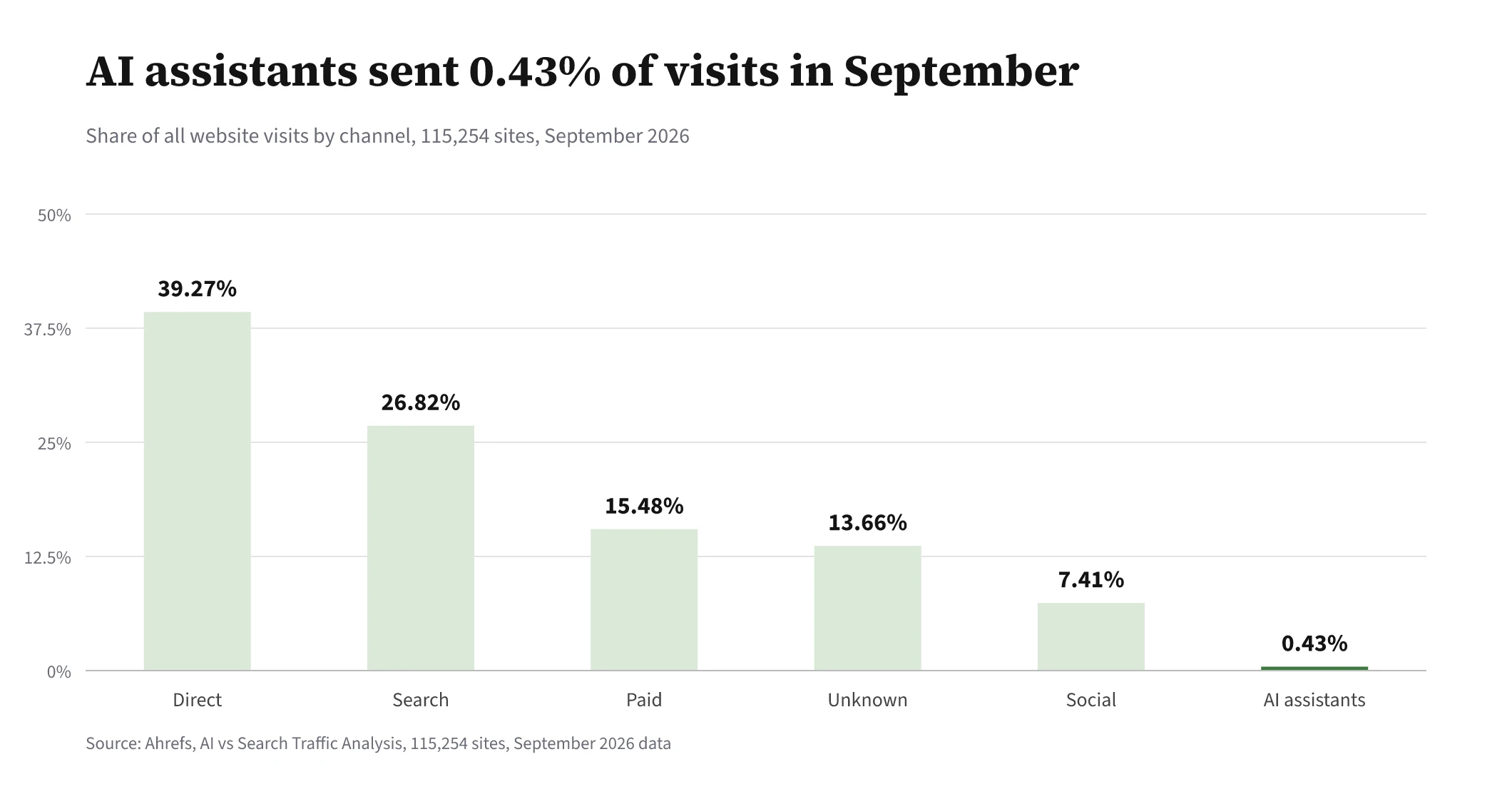
- SparkToro reported in June 2026 that 68.01% of US Google searches between January and April 2026 ended without a click, up from 60.45% in 2024.
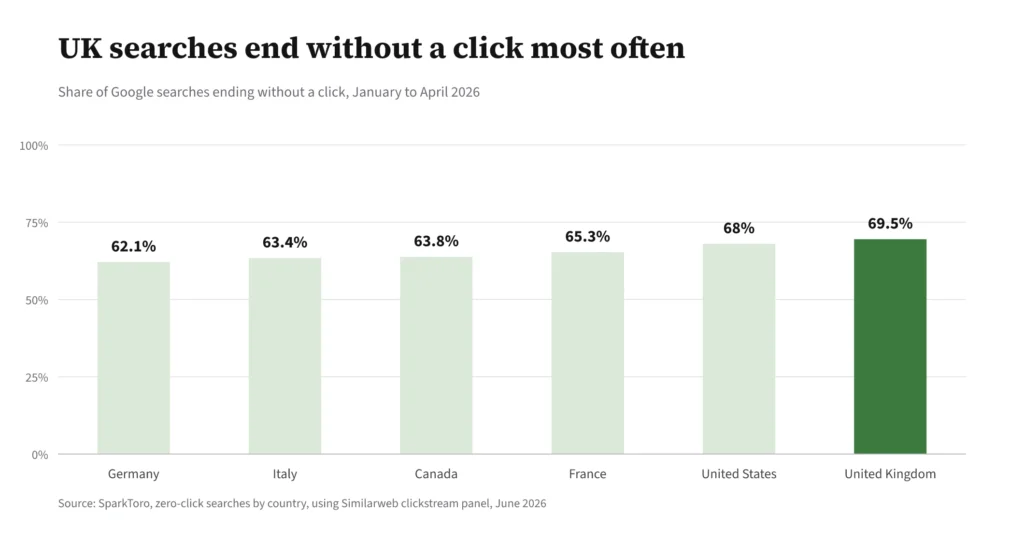
- SparkToro reported in June 2026 that the UK had the highest zero-click rate of six countries measured, at 69.5%, against 62.1% in Germany.
- Search Engine Land reported in September 2026 that AI assistants delivered about 1.6% of search traffic and revenue across 75 online stores.
- Adobe data reported by Digital Commerce 360 in August 2026 showed AI referral traffic to US retail sites up 62% year on year in July 2026.
- Digital Commerce 360 reported in October 2026 that Google began rolling out Universal Cart, a checkout inside Google Search and the Gemini app, in the US on 15 October.
- Google confirmed that its Search Console reports on AI features reached all websites worldwide as of 31 August 2026, showing impressions but no clicks.
This article covers what the latest click data says for online shops, why UK retailers have it hardest, what real growth looked like for three of our retail clients, how much AI assistants actually send, what Google’s Universal Cart means, and which numbers you should trust when rankings and clicks disagree.
Is SEO still worth it for an online shop in 2026?
Yes, but go in expecting fewer clicks per ranking than you got in 2023. The demand hasn’t gone anywhere: across 2,000 transactional keywords, search volume rose 2.2% over 12 months, according to data from 75 online stores in Search Engine Land’s ecommerce search trends report. People are still searching for things to buy.
What’s shrinking is the share of those searches that end on a website. SparkToro, using Similarweb’s mobile and desktop panel, found that 68.01% of US Google searches ended without a click between January and April 2026, up from 60.45% in 2024.
Key data: Ahrefs compared 300,000 keywords in December 2023 and December 2025 and found that when an AI Overview appears, the top-ranking page gets a 58% lower average click-through rate. For the number-one result on keywords with an AI Overview, CTR fell from 0.073 to 0.016.
The figure that surprised me more was the other one. On informational keywords with no AI Overview at all, position-one CTR still fell from 0.076 to 0.039. Clicks are thinning across the whole results page, not only where AI shows up.
Why it matters: If you set targets using 2023 click curves, a perfectly healthy campaign will look like it’s failing. The ranking still has value. It just turns into fewer visits.
Why do UK shops find clicks hardest to win?
Because UK searchers click through to websites less than anyone else SparkToro measured. In its June 2026 country comparison, the UK had the highest zero-click rate of six countries, at 69.5%, against 62.1% in Germany. UK searches send 232 clicks to the open web for every 1,000 searches.
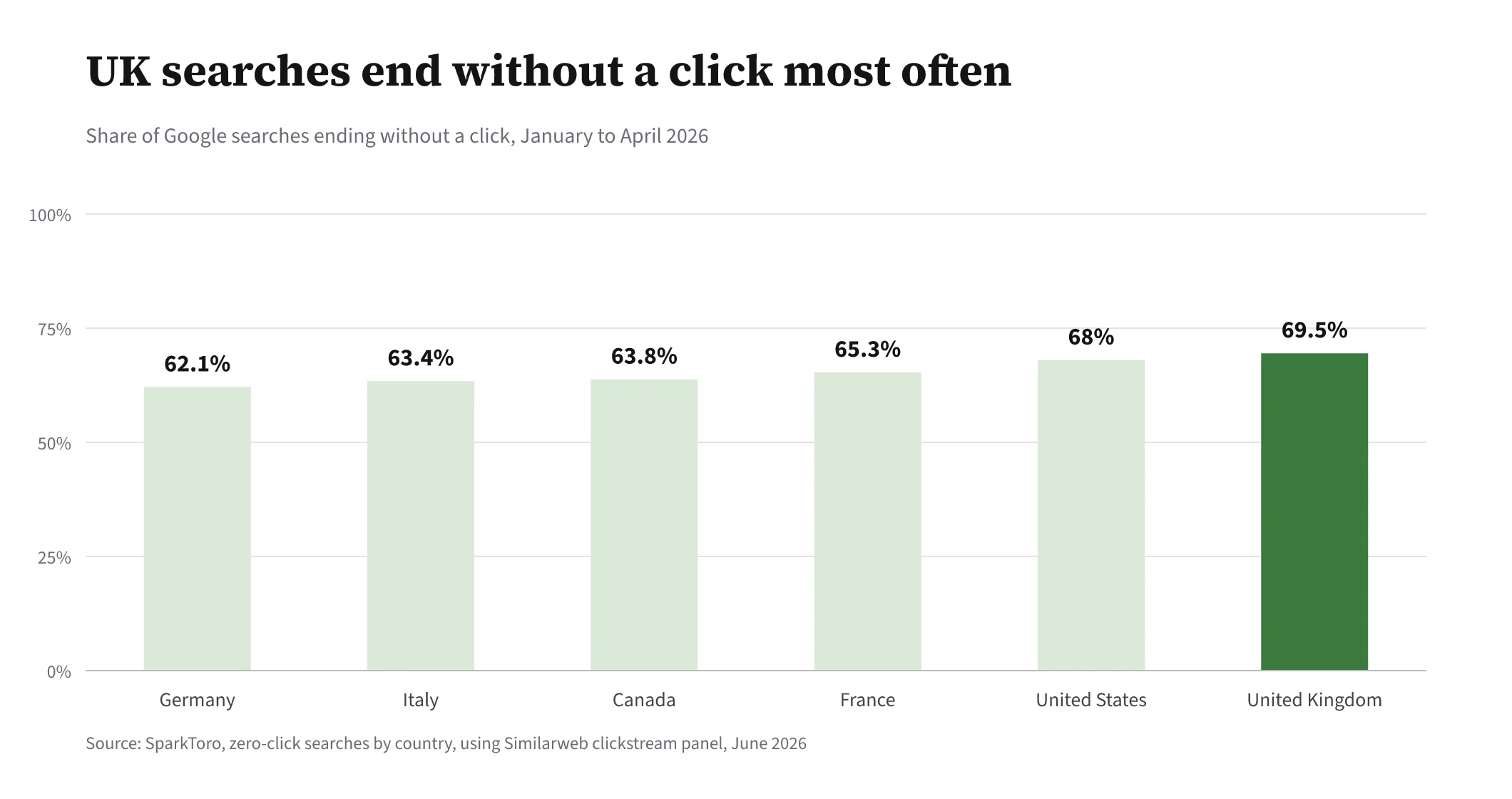
Put simply, fewer than a quarter of UK searches hand a visit to a website outside Google. If you sell to UK customers, you’re fighting over a smaller pool of clicks than a German or Canadian shop with identical rankings.
I don’t see that as a reason to give up on UK organic search. It is a reason to be realistic about what a new top-five position will bring, and to care much more about which of your pages win the clicks that remain.
What does organic growth look like for a shop in 2026?
It looks like rankings rising quickly and clicks rising slowly, and that is still real growth. Our clearest example is a UK car lighting retailer, selling into the market with the highest zero-click rate in the chart above.
The case study headline, as published: “Organic search visits rose 33% in the latest 12 months, and Google’s AI Overviews now link to the retailer’s pages for 1,479 different searches.” You can read how a UK car lighting retailer grew organic visits by a third in full.
Key data:
- Organic search visits in Google Analytics: 62,923 (October 2024 to September 2025) to 83,654 (October 2025 to September 2026), up 33%.
- Google Search clicks in September, from Search Console: 5,530 to 6,190, up 12%.
- Keywords in Google’s UK top 5: 3,757 to 5,598, up 49%.
- Links to the site inside AI answers across all engines: 1,921, with an estimated 1,655 monthly visits from AI answers.
Read those carefully. The 33% is a 12-month total from Google Analytics. The 12% is a single month from Search Console. They are different measures and shouldn’t be set side by side as if they were the same thing.
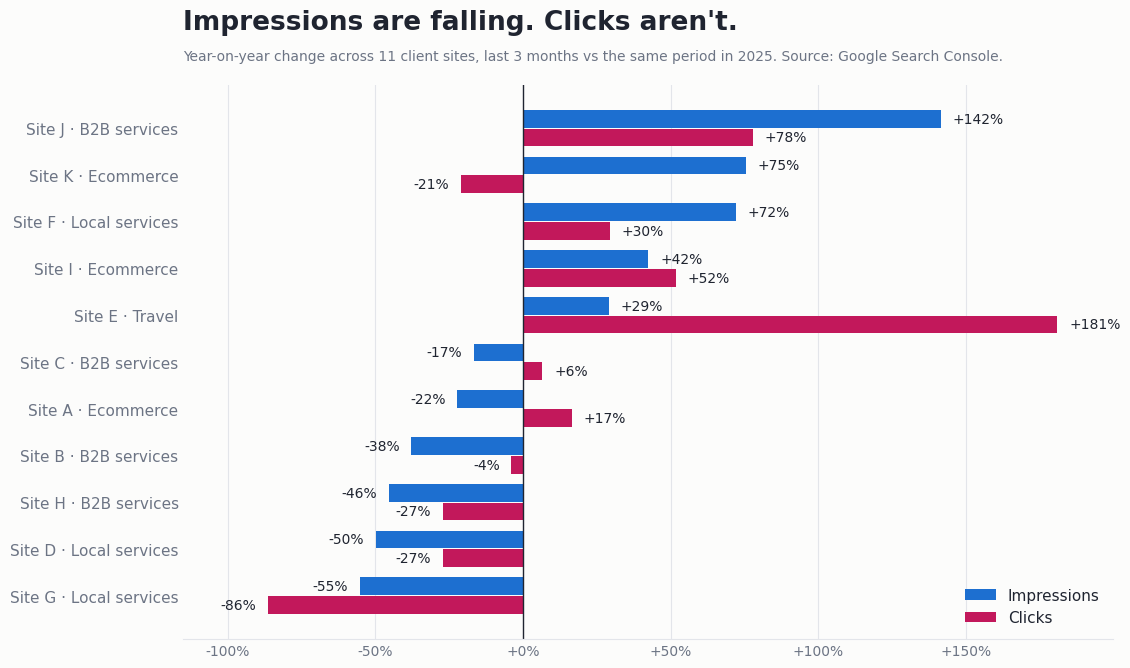
Why it matters: The telling comparison is top-five keywords up 49% against September clicks up 12%. Rankings grew roughly four times faster than clicks that month. We can’t prove AI Overviews caused that gap, but it is what you’d expect in a market where nearly seven in ten searches end without a click and AI Overviews cut clicks to top results.
The lesson for shop owners is simple. The work still pays, but the payoff per ranking is smaller, so plan your budget and your expectations around that.
Do AI Overviews actually appear on product searches?
Less often than on research questions, though nobody agrees on how much less. Published estimates range from 3.2% to 24%, and I’d read that spread as an honest sign that the data is still weak.
At the low end, Ahrefs analysed 146 million results pages and found AI Overviews on 3.2% of Shopping-category searches, 2.1% of transactional keywords and 4.3% of commercial keywords. At the high end, Search Engine Land reported 24% of shopping queries as of 3 September 2026, citing fresh Ahrefs data that Ahrefs hasn’t published. The same article said that presence had started to fall again in recent weeks.
What isn’t disputed is the product grid. An analysis of 4,000 commercial queries found that 96% of shopping searches show product grids, Kevin Indig wrote in Search Engine Land. His Growth Memo study of people shopping in AI Mode found that 88% of participants accepted the shortlist AI Mode gave them, and 74% chose the top-ranked product.
Why it matters: On a buying search, the fight is often in the product grid rather than the blue links. That’s where your product feed and your Google Shopping set-up matter as much as your category pages. And if AI Mode shoppers mostly take the top pick, second place on a shortlist is worth far less than first.
How much traffic do AI assistants actually send to online shops?
Not much yet, but it converts well. Across 75 online stores, mostly turning over $1m to $20m a year, about 1.6% of search traffic and revenue came from AI assistants, according to Search Engine Land’s September report. Those visitors converted at 1.82%, against 1.53% for non-branded organic search. That’s 19% higher.
Adobe’s figures for US retail sites point the same way. As reported by Digital Commerce 360, AI referral traffic in July 2026 was up 62% year on year and up 1,219% since October 2024, based on more than 1 trillion visits. AI-referred visits brought in 53% more revenue per visit and converted 60% more often than other visits.
The mix of assistants is shifting too. Among the largest North American online retailers tracked, the number with ChatGPT as their top AI traffic source fell from 844 to 722 between Q1 and Q2 2026. Gemini went from 16 to 32, and Claude from 1 to 15.
My view: huge growth percentages on a small base are easy to overreact to. At 1.6% of traffic, AI assistants deserve attention, not your whole budget. We’ve written separately about whether to move marketing budget from Google to AI search.
For shops, Google’s own AI features look far more important than the standalone assistants. Our US golf components supplier case study shows it plainly: of 1,241 links to the site in AI answers, 1,148 sit inside Google’s AI Overviews.
What does Google’s Universal Cart change for shop owners?
For now, only US retailers need to plan around it. On 15 October Google began rolling out Universal Cart, which lets people check out without leaving Google. According to Google’s announcement as reported by Digital Commerce 360, it is rolling out “in the U.S. across Google Search and in the Gemini app”. Checkout runs on Google’s Universal Commerce Protocol (UCP), and launch retailers include Ulta Beauty, Walmart, Wayfair and some Shopify merchants.
Why it matters: If a shopper can find, compare and buy without visiting your site, some sales will happen with no organic visit to record. Traffic becomes an even weaker stand-in for what search does for your business.
For UK and Australian shops, I’d watch this rather than act on it. My expectation is that complete, accurate product data will matter more each year, because the product grid, AI Mode’s shortlist and now a Google checkout all put your products in front of buyers before your own website does.
Which numbers should you trust when rankings rise but clicks don’t?
Trust Search Console clicks and your own analytics first, and treat third-party traffic estimates with real suspicion. Our Australian promotional products supplier case study is the clearest warning I can give. Top-five rankings rose 73%, from 2,598 to 4,501, and SE Ranking’s estimated monthly visits jumped 102%. Search Console clicks for June to September rose only 5%, which the case study page describes as “+5% (steady)”.
If you’d judged that campaign on the tool estimate, you’d have thought traffic had doubled. It hadn’t.
For AI visibility, the platforms are only now giving you data, and none of it includes clicks yet. Google says its Search Console reports on AI features were rolled out to all websites worldwide as of 31 August 2026. They show impressions, pages, countries, devices and dates, but Google’s help page for the reports lists no click metric.
Bing added Topics Portfolio (beta) to its AI Performance report this month. It groups the AI queries your site is cited for into topics, with Topic Size, Sites Cited and Queries for each, and a Top Opportunity Queries list shows where competitors are cited and you aren’t. As Search Engine Land points out, there’s no click data there either.
Use these reports to see where you appear, not to measure revenue. Our guide on how to measure AI visibility when there’s no rank to track goes further. For the full diagnosis of falling clicks, read 10 reasons your rankings hold but your clicks keep falling.
| Measure | Where it comes from | What it shows | Watch out for |
|---|---|---|---|
| Clicks | Google Search Console | Real clicks from Google Search | A single month can mislead; compare like with like |
| Organic visits | Google Analytics | Visits and revenue from organic search | Not the same measure as Search Console clicks |
| AI features appearances | Search Console AI features reports | Impressions, pages, countries, devices and dates | No click metric |
| AI citations | Bing AI Performance report and Topics Portfolio (beta) | Topics, sites cited, queries and opportunity queries | No click data |
| Estimated traffic | Third-party SEO tools | Modelled visits based on rankings | In one of our cases: +102% estimated against +5% Search Console clicks |
If you run an online shop, here is what I’d do this month. Pull 12 months of Search Console clicks and analytics revenue from organic search, put them beside your ranking report, and work out your own ratio of ranking growth to click growth. That is your realistic baseline, and it is far more useful than any tool estimate.
Then open the AI features report in Search Console and see which product and category pages already appear in AI answers. You can browse more retail results in our case studies, and if you’d like a second pair of eyes on your numbers, have a look at our ecommerce SEO service.
About the author
Shabir MS leads SEOValley Solutions and has worked in search since 2005. These days most of his time goes on how brands show up in AI answers, and on separating what the data actually shows from what gets said at conferences. Read more from Shabir MS.
Frequently asked questions
If my rankings are up but clicks have barely moved, is my SEO still working?
Quite possibly. For our UK car lighting retailer, top-five keywords rose 49% while September Search Console clicks rose 12%, yet organic visits over 12 months still grew 33%. Judge it on clicks, visits and revenue over a full year, not on rankings alone.
Can I see AI Overview clicks in Search Console yet?
No. Google’s AI features reports, available to all sites since 31 August 2026, show impressions, pages, countries, devices and dates, but Google’s help page lists no click metric.
Is traffic from ChatGPT and other AI assistants worth chasing for a shop?
It is small, about 1.6% of search traffic and revenue across 75 stores in Search Engine Land’s September data, but those visitors converted 19% better than non-branded organic search. Track it and build towards it, without starving your Google work of budget.
Will Google’s Universal Cart reach the UK or Australia?
The rollout that began on 15 October is US only, and we haven’t seen a date for other countries. Keeping your product data accurate and complete is the sensible preparation either way.
Are SEO tool traffic estimates reliable enough to judge an agency on?
Not on their own. In our Australian promotional products case, a tool estimated a 102% rise in monthly visits while Search Console clicks for June to September rose 5%, so always ask for Search Console and analytics figures.
Do AI Overviews show up on product searches?
Sometimes, but estimates vary widely, from 3.2% of Shopping-category searches in Ahrefs’ published study to 24% in unpublished Ahrefs data reported by Search Engine Land. Product grids are far more common, appearing on 96% of shopping searches in Growth Memo’s analysis.