+91 9893014167
  1 (888) 316-3286
 +44 20 3807 2189
 Chat on WhatsApp

Last updated: 19 September 2026
Your impressions are climbing. Your clicks are not. Somewhere between the query and your page, Google is answering the question itself, and the visitor never arrives.
Guessing at the scale of that problem is expensive. Commission six months of work aimed at earning a citation inside an AI answer, with no way to see whether a citation ever happened, and you have bought faith rather than marketing.
AI SEO is not a separate discipline with its own file formats and its own markup. Google states that its AI features run on core Search ranking, that it ignores llms.txt, and that no special schema is required. What has genuinely changed is measurement: since 31 August 2026, Search Console reports the impressions your pages earn inside AI Overviews and AI Mode.
Key facts
- Google rolled out the Search Console generative AI performance report to all websites worldwide on 31 August 2026, covering impressions in AI Overviews and AI Mode.
- That report exposes impressions, pages, countries, devices and dates. Google’s own Search Console documentation confirms it does not report clicks, click-through rate or average position.
- Google’s AI optimisation guide, published on Search Central in May 2026, states that Google Search ignores llms.txt files and other “special” markup, and that structured data is not required for generative AI search.
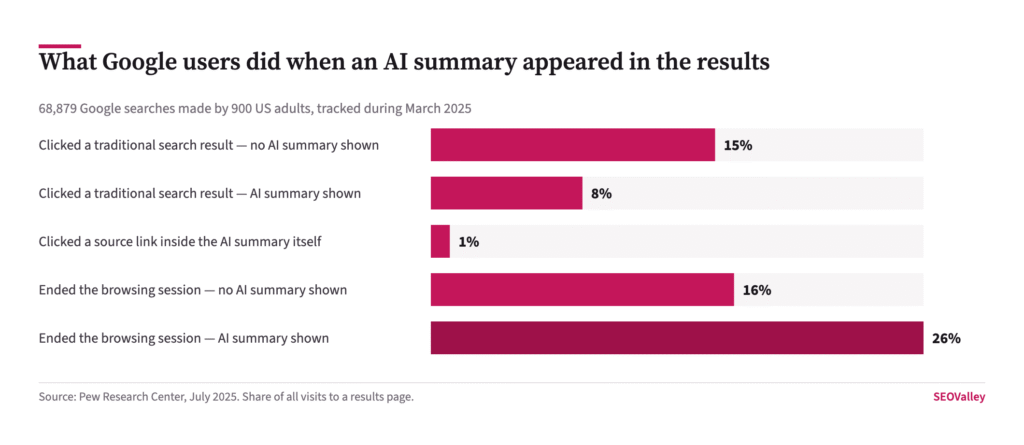
- Pew Research Center tracked 68,879 Google searches made by 900 US adults during March 2025 and found users clicked a traditional result on 8% of visits where an AI summary appeared, against 15% where none did.
- In that same Pew dataset, users clicked a source link inside the AI summary itself on just 1% of visits.
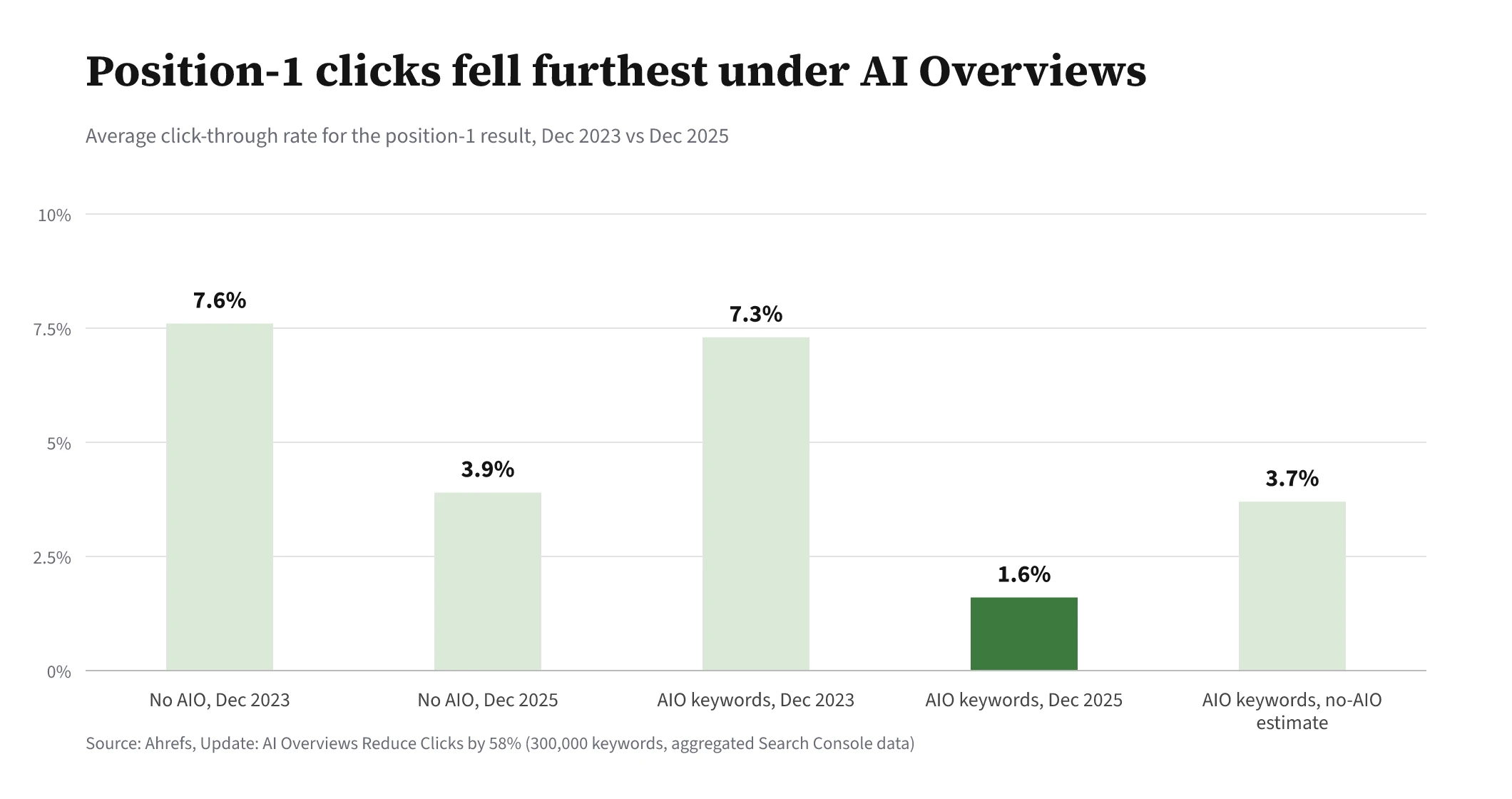
- Ahrefs compared 300,000 keywords between December 2023 and December 2025 and measured a 58% lower average click-through rate for the top-ranking page when an AI Overview was present.
- Semrush, analysing more than 500 marketing topics rendered as prompts, found ChatGPT cites pages ranking position 21 or below in ordinary Google search almost 90% of the time.
This article sets out what the evidence supports, which widely sold AI SEO tactics Google says it disregards, and the specific checks that tell you where your own site stands. It is ordered from measurement to tactics, because the measurement now exists and the tactics should answer to it.
Is AI SEO actually different from SEO?
Not in the way most of the market implies. Google’s official guide to optimising for generative AI features puts it in one line: optimising for generative AI search is optimising for the search experience, and thus still SEO.
What it looks like: a proposal arrives offering “AI SEO” as a new service line with a new methodology and a new price.
Key data: Google states that its generative AI features draw on core Search ranking systems, and that existing SEO best practices continue to apply.
Why it matters: if you buy AI SEO as a parallel programme, you pay twice for the same technical and editorial work, and you get a second roadmap that competes with the first for the same engineering time.
The check: take any AI SEO proposal and mark each line item against Google’s guide. Anything that survives — crawlable pages, distinctive content, sound page experience, correct canonicals — was already SEO. Anything that does not survive, you can decline with a citation.
The honest distinction is narrower and worth naming. Traditional SEO optimises for a ranked list you can measure with clicks and positions. Generative systems synthesise an answer and may cite nobody at all. The work is largely the same; the feedback loop is not. That is where the real difficulty sits, and it is a measurement problem rather than a markup problem. Our AI SEO service treats it that way.
Where can you actually see your AI search visibility now?
In Search Console, in a report that did not exist for most sites until three weeks ago. Google announced the generative AI performance reports on 3 June 2026 and completed the worldwide rollout on 31 August 2026.
What it looks like: a new entry under Performance, separate from the familiar Search results report.
Key data: the report covers impressions in AI Overviews and AI Mode, broken down by pages, countries, devices and dates, with hourly, daily, weekly and monthly granularity.
Why it matters: for two years the honest answer to “are we being cited?” was that nobody could tell you from first-party data. That answer expired three weeks ago, and any report still repeating it is working from stale documentation.
The check: open Search Console, select the property, and in the left-hand navigation expand Performance. Choose the generative AI entry rather than Search results. Switch to the Pages tab and sort by impressions. Those are the URLs Google is surfacing inside its AI answers. Export both the chart and the table before you change anything, so you have a baseline dated before your work started.
If the report is missing, there are only two likely reasons. Your property has not received enough impressions in generative AI features, or you have excluded your site from them. The second is worth ruling out deliberately, because it is possible to opt out without meaning to.
What does the Search Console generative AI report refuse to tell you?
Clicks. The report shows impressions and nothing else in the way of performance metrics — no clicks, no click-through rate, no average position. Google’s Search Console documentation for the report is explicit about what the default view contains.
What it looks like: a chart that rises encouragingly, with no way to know whether any of it produced a visit.
Key data: the available dimensions are Pages, Countries, Dates and Devices. The usual Search Console limits apply, including the 1,000-row table cap. Data from Search Labs experiments is excluded.
Why it matters: an impressions-only metric is easy to make go up and hard to tie to revenue. It is exactly the sort of number that gets put on a slide because it is available rather than because it matters.
The check: export the generative AI report and the standard Search results report for the same date range, then compare the page lists. A URL with heavy generative AI impressions and falling clicks in the standard report is being read rather than visited. That is a content decision, not a technical fault.
Treat the number as a visibility signal and say so plainly in reporting. Pairing it with a click figure it does not contain would be a fabrication, and the same discipline applies here as in any diagnosis of rankings holding while clicks fall.
How much does an AI Overview really cost you in clicks?
Roughly half of them at the top of the page, on the best available evidence. Ahrefs compared 300,000 keywords — 150,000 with an AI Overview present and 150,000 informational keywords without — between December 2023 and December 2025, using aggregated Search Console click and impression data.
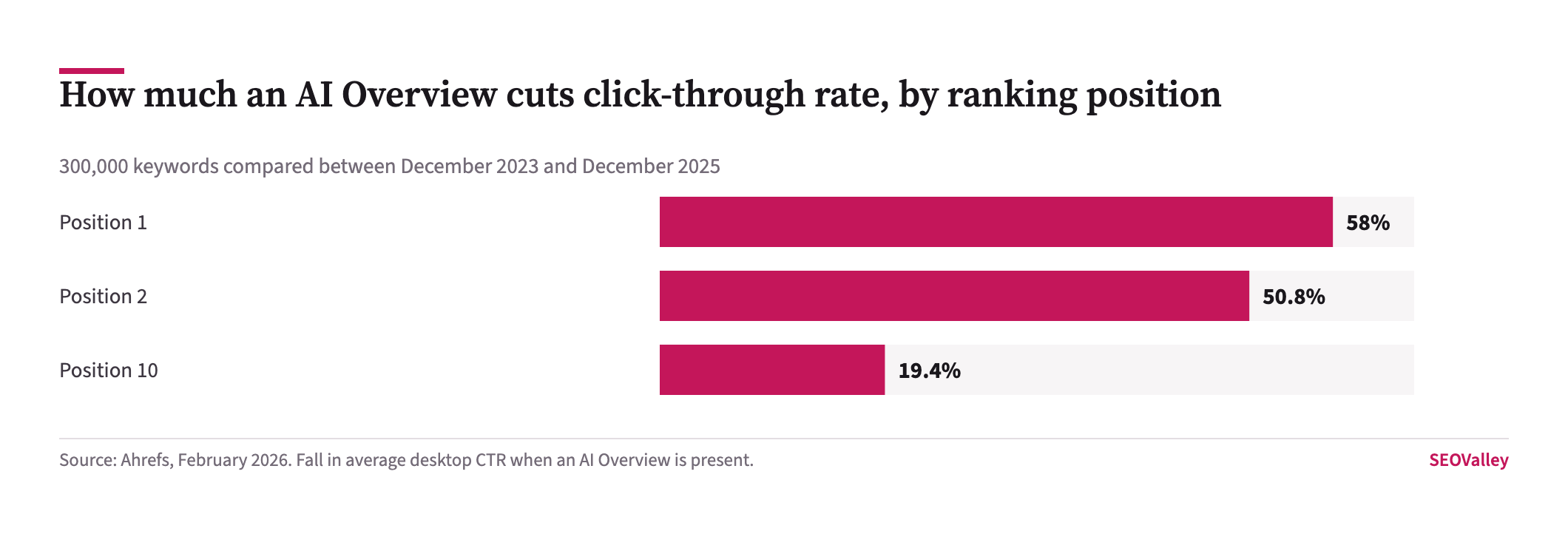
Key data: position one lost 58% of its expected click-through rate, falling from a forecast 0.037 to an observed 0.016. Position two lost 50.8%. Position ten lost 19.4%.
Why it matters: the sites hurt most are the ones that were winning. A page that has held position one for years is losing more, in proportion, than the page sitting at position ten beneath it.
The check: in Search Console, open the standard Performance report, switch the date range to Compare and set the last three months against the same period a year ago. Add a query filter for your informational head terms. If impressions hold and clicks fall on precisely those queries, you are looking at the same effect Ahrefs measured, on your own data.
The Pew Research Center study arrives at the same conclusion from user behaviour rather than from keyword samples, which is why the two are worth citing together. Independent methods reaching similar numbers is the closest thing to confirmation this field offers.
Some of those clicks are not recoverable by anyone, at any budget. A query with a one-sentence answer has been surrendered. The work is to identify which of your queries are genuinely like that, and stop spending on them.
Which sources do AI systems cite, and why is it so rarely you?
Because they lean heavily on a small set of large community and reference platforms. Peec AI analysed 30 million cited sources across ChatGPT, Google AI Mode, Gemini, Perplexity and AI Overviews, and published the ranking in March 2026.
Key data: Reddit was the most-cited domain overall, followed by YouTube, LinkedIn, Wikipedia and Forbes. The preference varies by engine — ChatGPT favoured Wikipedia, Reddit and Forbes; Perplexity leaned towards Reddit, LinkedIn and G2.
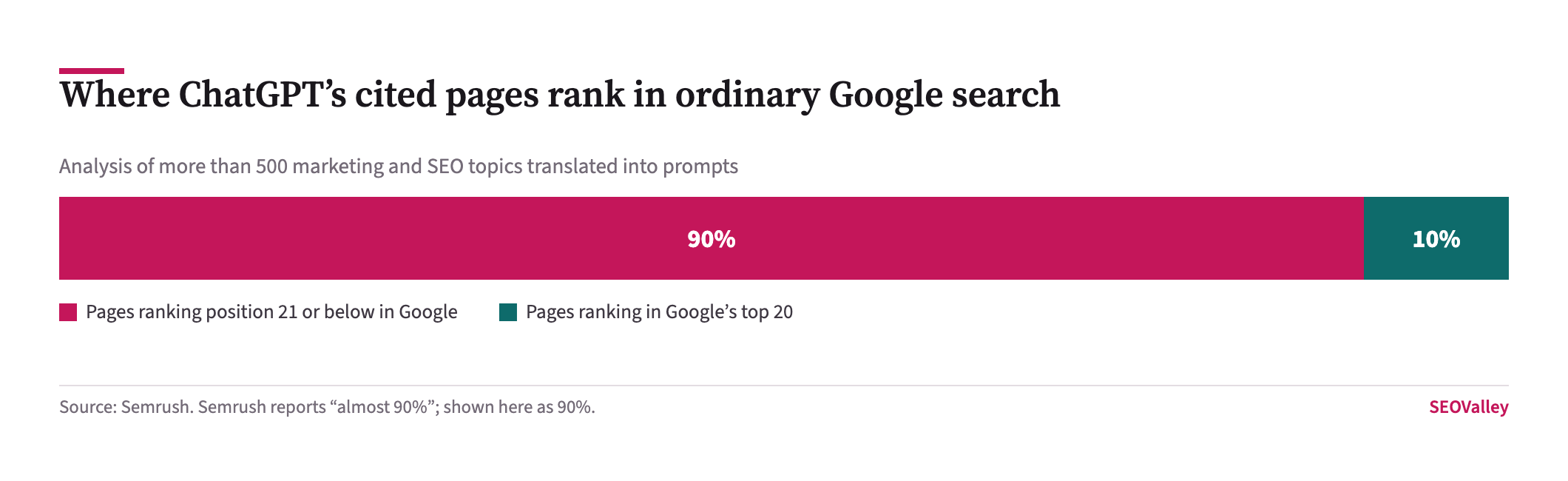
Why it matters: two things follow. Your own domain is competing with Reddit for a citation slot, and your ranking position is a poor predictor of whether you get one. Semrush found ChatGPT cites pages from position 21 or below almost 90% of the time.
The check: take your ten highest-value commercial questions and put each one to ChatGPT, Gemini and Perplexity as a customer would phrase it. Record which domains are cited. Where a community platform is cited instead of a vendor, that is a surface you can participate in honestly; where a competitor is cited, read the page that earned it.
The practical conclusion is uncomfortable for anyone selling on-page tweaks. A meaningful part of AI visibility is earned off your own domain, on surfaces such as YouTube and in communities where your expertise is visible under a real name. That is slower than editing a title tag and it does not fit neatly into a monthly retainer.
Does an llms.txt file do anything for you?
Not for Google. Its AI optimisation guide names llms.txt directly and says Google Search ignores it, along with other “special” markup created for AI systems.
Why it matters: llms.txt has been a widely recommended deliverable through most of 2025 and 2026, and it was a reasonable thing to try before Google addressed it directly. Now that Google has, the hours behind it are better spent on the crawlability and answer-structure work further down this page.
The check: request the crawl logs for your own llms.txt file. If Googlebot and Google-Extended are not requesting it, it is not being read by the system you care most about.
The fair qualification: Google speaks only for Google. No engine has published evidence that llms.txt changes citation behaviour, and absence of evidence is not proof. Until some engine publishes something, the hour is better spent on work Google has said it does read.
Do you need special schema markup to be cited?
No. Google states that structured data is not required for generative AI search and that there is no special Schema.org markup to add for it.
Why it matters: this cuts against a great deal of current advice, including advice that recommends inventing properties or marking up content purely so a model will read it.
Keep your structured data regardless, for a different reason. Article, Product, FAQPage, Organization and BreadcrumbList still earn rich results in ordinary search, still clarify entities, and still cost little to maintain. The case for structured data and rich snippets stands on its own; it simply is not a AI SEO tactic. Mark up what is visible on the page and nothing else.
Should you break your content into chunks for AI systems?
There is no requirement to. Google’s guidance says explicitly that content need not be broken into small pieces, and that rewriting content specifically for AI systems is unnecessary because they understand synonyms and general meaning.
Why it matters: chunking advice has produced a wave of pages written in disconnected fragments that serve no reader well. The cost lands on the humans who still arrive.
The check: read a recent page aloud. If it sounds like a list of statements assembled for a machine, it will read that way to a customer deciding whether to trust you.
Clear sections and honest headings help everyone, which is why Google notes that people appreciate pages organised into paragraphs and sections. Structure for the reader and the extraction follows; structure for the extractor and you lose the reader.
How do you measure AI visibility outside Google?
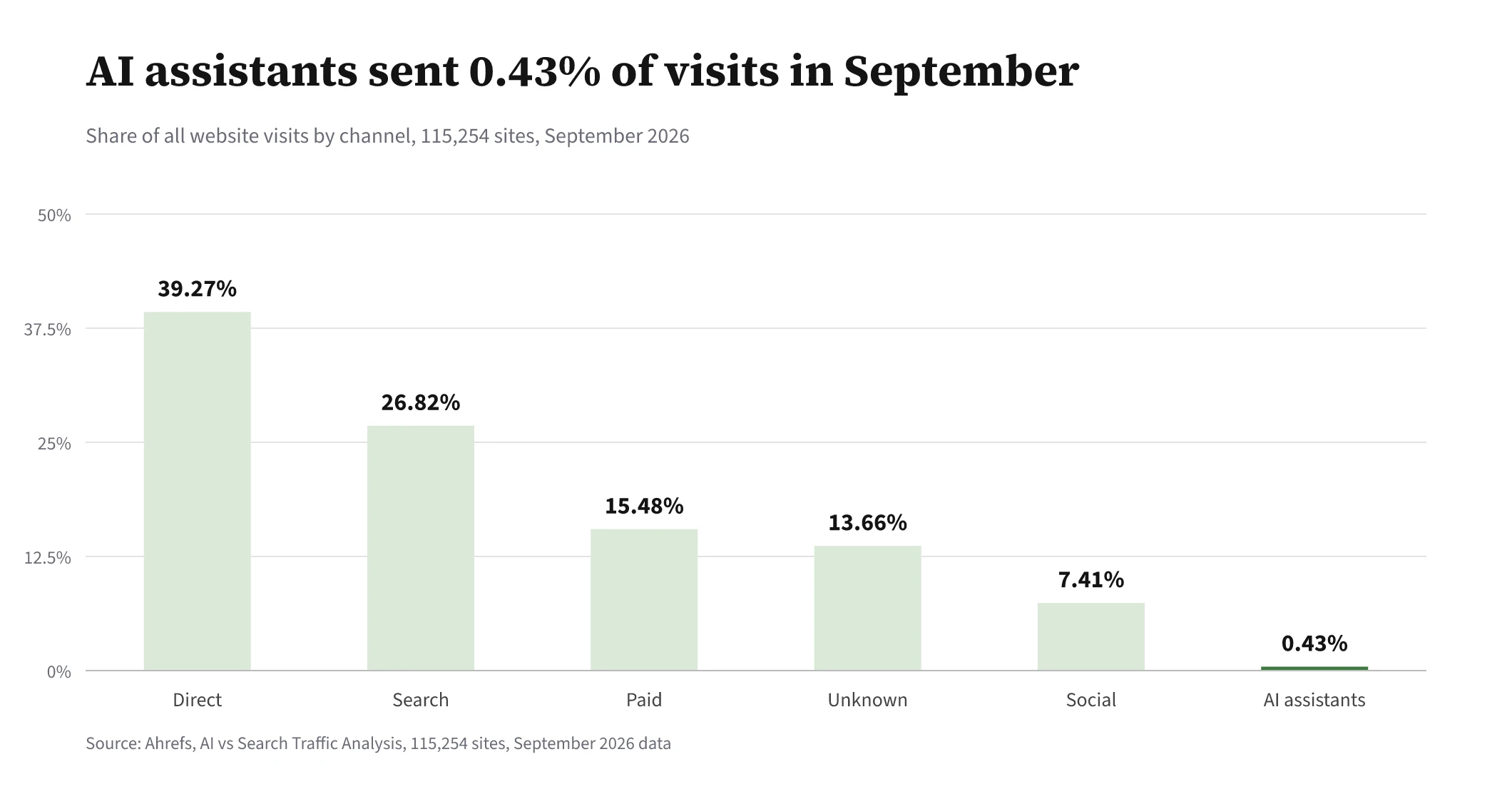
Through referral traffic in analytics, which is the only first-party signal the other assistants give you. Search Console covers Google’s surfaces and nothing else.
The check: in Google Analytics 4, open Reports, then Acquisition, then Traffic acquisition. Set the primary dimension to Session source / medium and apply a filter matching chatgpt.com, perplexity.ai, gemini.google.com, copilot.microsoft.com and claude.ai. Add conversions as a secondary metric so the report answers a commercial question rather than a curiosity.
Why it matters: these referrals are frequently mislabelled as direct traffic when an assistant strips the referrer, so the number you see is a floor rather than a measurement. Say so when you report it.
Build the segment once and leave it running. A properly configured GA4 property will show the trend within a quarter, and a trend you have watched for a quarter is worth more than a competitor benchmark you bought.
Is a visit from an AI assistant worth more than an organic visit?
The available evidence says yes, and the available evidence is thin. Semrush reports that the average AI search visitor is 4.4 times as valuable as the average visit from traditional organic search, measured by conversion rate, across an analysis of more than 500 topics.
Why it matters: a 4.4 multiplier changes how you value a small number of sessions. Nine per cent of traffic converting at four times the rate is not a rounding error.
The limitation deserves equal billing. Semrush publishes the multiplier without the underlying conversion rates, so there is no way to check it against your own baseline. Treat it as a reason to measure AI referrals properly on your own property, not as a number to put in a forecast. If your own GA4 data disagrees with it, your own data wins.
What should you actually change on the site?
Four things, in this order, and none of them are new inventions.
Confirm you have not opted out. Check that pages are not carrying nosnippet or restrictive max-snippet directives left over from an earlier policy, and that the Search generative AI control in Search Console has not excluded the property. A site cannot be cited from behind a wall it raised itself.
Answer the question in the first sixty words of the page, in a passage that makes sense quoted on its own. Systems that extract a single passage will extract the one that reads as a complete answer, and a reader who stops there should still have what they came for.
Publish something that is not already on the web. Google’s guidance asks for non-commodity content with a distinctive perspective, which in practice means your own data, your own tests and your own conclusions. A synthesis of the first ten results has nothing to cite.
Fix crawlability before anything else, because generative features draw on publicly accessible crawlable content. A page that renders only after a client-side fetch is a page that may never be read. A technical SEO audit that checks rendering rather than just response codes will find these.
Which AI SEO tactics survive scrutiny
| Tactic | What Google says | Verdict |
|---|---|---|
| Publishing an llms.txt file | Google Search ignores llms.txt and other special markup | Reallocate the effort |
| Adding AI-specific schema properties | Structured data is not required for generative AI search | Keep normal schema, invent nothing |
| Chunking content into fragments | No requirement to break up content | Structure for readers instead |
| Rewriting pages for AI systems | AI understands synonyms and general meaning | Unnecessary |
| Answering in the first 60 words | Organised, people-first content is rewarded | Worth doing |
| Fixing crawlability and rendering | Generative features use publicly accessible crawlable content | Do this first |
Symptom, cause and how to confirm it
| Symptom | Likely cause | How to confirm |
|---|---|---|
| Impressions rising, clicks falling on informational queries | AI Overview absorbing the answer | Search Console Performance, Compare mode, last 3 months against the same period last year |
| No generative AI report visible in Search Console | Too few AI impressions, or the property is excluded | Check the Search generative AI control in Search Console settings |
| Cited by ChatGPT but no matching traffic | Referrer stripped, sessions counted as direct | GA4 Traffic acquisition filtered to assistant domains, compared with direct trend |
| Competitors cited for your core questions | Their page answers in one extractable passage | Run the ten questions manually across ChatGPT, Gemini and Perplexity and read the cited pages |
| Reddit or Wikipedia cited instead of any vendor | Engine preference for community and reference sources | Peec AI domain ranking, plus your own prompt testing |
| AI SEO work delivered but nothing measurable changed | Tactics Google ignores, such as llms.txt | Compare the deliverables against Google’s AI optimisation guide |
What to do first, and what to stop paying for
AI SEO earns its keep as a measurement practice rather than a markup practice. Google runs its AI features on core Search ranking, ignores llms.txt, and asks for no special schema — so the tactics that remain are the ones that were already good SEO, and the genuinely new thing is that Search Console now shows you AI Overviews and AI Mode impressions for every property.
The single next action is to export the generative AI performance report today and store it with the date. Every claim anyone makes about your AI visibility from this point should be checked against that baseline, including ours.
What not to do: do not spend on llms.txt, invented schema properties, or a content-chunking exercise — put that time into crawlability and into answering the question in the first sixty words. And do not report impressions as though they were clicks. Do not abandon informational content either — the queries that lost the click are a subset, not the whole library, and diagnosing which queries actually fell is what separates a considered retreat from a panic. If the report shows your pages are being surfaced and your revenue is flat, the problem is what the page says after the click, not whether a model can see it.
If you want this run properly, our AI SEO and blog marketing teams work from the baseline export rather than from a template.
Related case study: UK Automotive Parts Retailer: 33% more organic visits, 1,921 AI links. More results on our case studies page.
About the author
Shabir MS leads SEOValley Solutions, where he has worked in search since 2005 and now oversees technical audits and search strategy for clients across the US, UK and Australia. He spends most of his week in Search Console and GA4 rather than in slide decks, which is where the checks in this article come from. Read more from Shabir MS.
Frequently asked questions
What is AI SEO?
It is the practice of making a site visible inside AI-generated answers. Google treats it as ordinary SEO, because its AI features run on core Search ranking rather than a separate system.
Can I see whether Google cites my site in AI Overviews?
Yes, since 31 August 2026. The generative AI performance report in Search Console shows impressions from AI Overviews and AI Mode, grouped by page, country, device and date.
Does the Search Console generative AI report show clicks?
No. It reports impressions only. There is no clicks metric, no click-through rate and no average position, so it cannot be used to claim traffic from AI features.
Does Google read llms.txt?
No. Google’s AI optimisation guide states that Google Search ignores llms.txt files and other special markup created for AI systems. No other engine has published evidence that it helps.
Do I need new schema markup to appear in AI answers?
No. Google states structured data is not required for generative AI search. Keep existing structured data for rich results in ordinary search, and never mark up content that is not visible.
How much traffic do AI Overviews cost a site?
Ahrefs measured a 58% fall in click-through rate at position one across 300,000 keywords. Pew found clicks on a result dropped from 15% of visits to 8% when a summary appeared.