+91 9893014167
  1 (888) 316-3286
 +44 20 3807 2189
 Chat on WhatsApp
Last updated: 11 October 2026
Type “best accounting software” into Google and you’ve written a keyword. Ask ChatGPT “I run a five-person plumbing firm in Leeds, we invoice on site and my bookkeeper uses Xero, should I switch?” and you’ve written something no keyword tool has ever seen.
So do keywords still matter? Yes. They have stopped being the unit you optimise a page for and become the evidence of what people want. Behind every long prompt, AI search engines still run ordinary searches, and those searches still match words and topics on real pages.
What has changed is how you find them, how you group them, and how much you should care about any single phrase.
Key facts
- Semrush found in July 2025 that the average Google AI Mode query was 7.22 words against 4.0 words for a traditional search, across almost 69 million US desktop sessions.
- Semrush reported in April 2026 that between 65% and 85% of ChatGPT prompts could not be matched to any traditional search keyword in its database for most of a 17-month study.
- Google described query fan-out in March 2025 as issuing multiple related searches concurrently across subtopics and data sources.
- Pew Research Center found in July 2025 that Google searches of 10 or more words produced an AI summary 53% of the time, against 8% for one or two words.
- Google’s guide to generative AI search, updated in July 2026, says sites don’t need to worry about capturing every long-tail keyword variation.
- The same Google guide warns that creating separate content for every possible search variation, including fan-out queries, to manipulate rankings breaks its scaled content abuse policy.
This article covers how long AI prompts really are compared with classic searches, what query fan-out does with them, why entities and topics now carry more weight than exact phrases, what Google itself says about keywords for AI search, and what keyword research looks like in practice today.
How much longer are AI prompts than Google searches?
Roughly twice as long in Google’s AI Mode, and far longer in ChatGPT when it isn’t searching the web. Semrush’s study of almost 69 million Google sessions between May and July 2025 found the average AI Mode query ran to 7.22 words, against 4.0 for a traditional search.
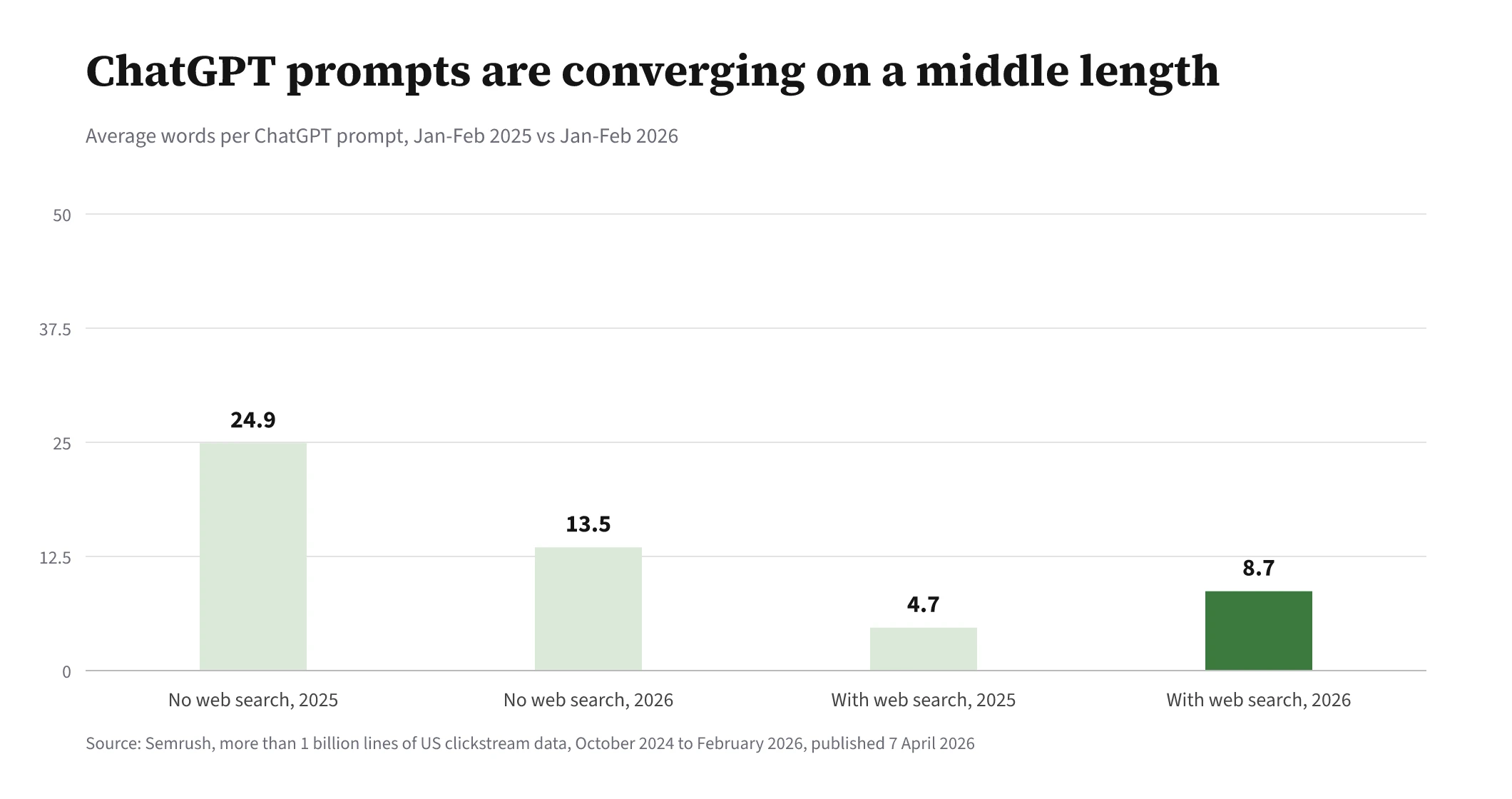
ChatGPT is more interesting. Semrush’s later analysis of more than a billion lines of US clickstream data, published in April 2026, compared January and February 2025 with the same months of 2026. Prompts that didn’t trigger a web search fell from 24.9 words on average to 13.5. Prompts that did trigger search rose from 4.7 words to 8.7.
So the two are meeting in the middle. Chat prompts are getting shorter as people learn what works, and search-style prompts are getting longer as people stop writing like it’s 2010. Either way, the four-word head term is no longer how most questions arrive.
What is query fan-out, and why does it matter for keywords?
Query fan-out is the AI breaking one question into many smaller searches, running them at once, and stitching the results into a single answer. Google introduced the term in March 2025 when it launched AI Mode, describing it as issuing multiple related searches concurrently across subtopics and multiple data sources.
Google’s own example, in its guide to generative AI search, is a person asking “how to fix a lawn that’s full of weeds”. The fan-out queries might include “best herbicides for lawns”, “remove weeds without chemicals” and “how to prevent weeds in lawn”.
Look at those three. They are keywords. Short, ordinary, the sort you’d find in any keyword tool. That is the part people miss: the prompt is long, but what the machine searches for underneath is often familiar.
The practical lesson is that ranking for the sub-questions matters. A page that answers “how to prevent weeds in lawn” well has a chance of being pulled into an answer for dozens of longer prompts it was never written for.
If AI understands meaning, why do exact words still count?
Because retrieval still starts with matching, and matching still leans on words, names and things. The AI can understand that “boiler service” and “annual gas boiler check” mean the same job. It still needs a page that clearly says what it is about.
This is where entities come in. An entity is a specific, recognisable thing: a product, a place, a company, a standard, a person. “Xero”, “Leeds”, “Making Tax Digital” and “VAT return” are entities. Pages that name the right entities clearly, and explain how they relate, are easier for both Google and AI systems to place.
Pages cited in AI answers rarely contain a long prompt word for word, because nobody writes pages that way. They do contain the nouns. The exact phrase matters less than it did; the subject matter matters more. Our look at what gets cited in AI Overviews goes into how this varies by type of query.
What does Google actually say about keywords and AI search?
Google is unusually direct about it. Its generative AI guide, last updated in July 2026, says AI systems can understand synonyms and general meanings, and that “you don’t have to worry that you don’t have enough ‘long-tail’ keywords or haven’t captured every variation of how someone might seek content like yours.”
It also warns against the obvious overreaction. Creating separate content for every possible variation of how people might search, including fan-out queries, primarily to manipulate rankings or AI responses, breaks Google’s scaled content abuse spam policy.
I agree with both points, and I’ve watched sites ignore them. Building 200 near-identical pages for every phrasing of “cost of a loft conversion in [town]” was a weak idea in 2018. In 2026 it is also a policy risk. Google’s line is that optimising for AI search is still SEO, and that the content which wins is the non-commodity kind: first-hand experience and specific detail, not a summary of what everyone else has written.
Are some keywords more likely to trigger AI answers than others?
Yes, and query length is a strong signal. Pew Research Center’s study of 68,879 Google searches made in March 2025 found that searches of one or two words produced an AI summary only 8% of the time. Searches of 10 words or more produced one 53% of the time. Searches starting with question words such as who, what, when or why produced one 60% of the time.
That is useful for planning. Short commercial terms, like a service plus a town, are still mostly classic results with ads and a map pack. Long questions are where AI answers live.
So split your keyword list by intent and length. For short commercial terms, the old rules of ranking and click-through still apply. For long informational questions, the aim shifts to being one of the sources the answer is built from, and to being the brand the answer names.
What does keyword research look like now?
It starts with questions and topics, and uses keyword data to size and confirm them rather than to dictate copy. Here is the order we’d suggest for a business doing it properly in 2026:
- Collect real questions. Sales calls, enquiry forms, reviews, support emails and the Queries report in Search Console. These are the prompts your buyers type, in their own words.
- Map the fan-out. For each big question, list the sub-questions an AI would need answered: cost, timing, comparisons, risks, local rules.
- Size with keyword data. Search volumes still tell you which sub-questions matter most. Treat them as a ranking of demand, not a script.
- Group into topics, not phrases. One strong page per sub-question, connected through sensible internal linking, beats ten thin pages chasing variants.
- Name the entities. Products, places, standards, prices and people, written plainly.
- Track prompts as well as keywords. Keep a fixed set of buyer prompts and check monthly whether AI answers mention or cite you.
Notice what’s missing: keyword density, exact-match title formulas, and pages for every spelling. Those were overrated even before AI arrived. The classic mistakes in our older piece on keyword research mistakes still apply; there are just fewer reasons to make them.
| Then: classic keyword research | Now: research for AI and classic search |
|---|---|
| Start with a seed keyword and a volume list | Start with real customer questions and prompts |
| One page per keyword variant | One page per sub-question or topic |
| Exact match in title, H1 and copy | Clear subject, named entities, plain answers |
| Head terms of two to four words | Long questions plus the short fan-out searches behind them |
| Track rankings only | Track rankings, clicks, AI mentions and citations |
| Volume decides priority | Volume plus intent and business value decide priority |
Where is the data on prompts still weak?
Almost everywhere, and you should be sceptical of anyone selling certainty. OpenAI doesn’t publish prompt volumes. Google doesn’t show fan-out queries in Search Console. Most prompt “volume” figures are estimates from clickstream panels or modelled from search data.
Semrush’s own 2026 study shows the gap: for most of its 17 months, between 65% and 85% of ChatGPT prompts couldn’t be matched to any traditional keyword in its database. That is a large blind spot, and it cuts both ways. Keyword tools miss much of what people ask, but no tool yet measures prompts as reliably as Search Console measures queries.
So keep using keyword data where it is solid, and treat prompt data as directional. The two together give a fuller picture than either alone.
Take your current keyword list and do one thing this week: next to each keyword, write the real question a buyer would ask that contains it. You will find some keywords have no question behind them and can go. You will also find questions you have no page for.
That second list is where the work is. SEOValley has been doing keyword research since 2005, and the method has changed more in the last two years than in the fifteen before. If you want help building a topic map that works for Google and AI answers together, see our AI SEO services.
About the author
Shabir MS leads SEOValley Solutions and has worked in search since 2005. These days most of his time goes on how brands show up in AI answers, and on separating what the data actually shows from what gets said at conferences. Read more from Shabir MS.
Frequently asked questions
Should I still use keywords in page titles?
Yes. A clear title that names the topic in the words buyers use still helps both Google and AI systems understand the page. Just write it for a person, not as a stack of phrases.
Is keyword search volume still useful?
Yes, as a measure of demand between topics. It undercounts long conversational questions, so use it to rank priorities rather than to decide every word on the page.
Can I see which fan-out queries Google ran for my page?
No. Google does not show fan-out queries in Search Console. You can infer likely sub-questions by breaking your buyers’ main questions into their parts.
Should I create a page for every question people ask AI?
No. Google’s guide warns that making separate content for every variation to manipulate results breaks its scaled content abuse policy. Answer related questions together on one strong page where they belong together.
Do keywords matter for ChatGPT and Perplexity too?
Indirectly, yes. When they search the web, they run short searches and pick sources from the results, so pages that clearly cover a topic with the right terms and entities are easier to find and cite.