+91 9893014167
 1 (888) 316-3286
 +44 20 3807 2189
 Chat on WhatsApp



If you run a business and follow search news, the last fortnight was confusing. Alphabet shares had their worst day in more than 20 years, Google told investors that AI Mode earns less per search, and someone on X claimed the AI Mode button had disappeared.
So does AI Mode send traffic? Yes, but far less per search than normal Google. The first randomised experiment found click-through to external websites fell by 18.8 percentage points when every search went to AI Mode. Very few people use it that way yet, though, so for most businesses AI Overviews are the bigger traffic problem today, and AI Mode is the one to prepare for.
Key Facts
- A preregistered field experiment of 1,100 US Google users, published on arXiv on 18 August 2026, found that sending every search into AI Mode cut click-through to external websites by 18.8 percentage points.
- In that same study’s normal baseline, only 0.6% of searches used AI Mode while 36% triggered an AI Overview (arXiv, 18 August 2026).
- On Alphabet’s Q3 earnings call on 28 October 2026, Sundar Pichai said AI Mode queries are on average three times longer than traditional searches (Motley Fool transcript, 29 October 2026).
- On the same call, Philipp Schindler said strong AI Mode growth held back revenue because of lower monetisation in AI Mode, and that the majority of AI Mode queries are incremental.
- Google’s Search blog post of 15 October 2026 said it is adding more inline links to AI answers, showing them higher more often, and testing a section for official sites.
- Search Console’s Generative AI performance reports reached all websites on 31 August 2026 and show AI Mode impressions but no click metric, according to Google Search Central.
- Google Search revenue grew 12% year on year to $63 billion in Q3 2026, according to the Motley Fool transcript published on 29 October 2026.
This article covers what the first causal study on AI Mode actually found, what Google told investors in October, whether AI Mode is about to replace normal search, the changes Google is making to send more clicks, and what we would do about it if we were in your seat, with one of our own case studies as a reality check.
How Many Clicks Does AI Mode Actually Send?
Far fewer than normal Google, if the only randomised experiment we have is any guide.
What it looks like: In March 2026, researchers at Penn and Northeastern redirected every Google search made by a group of US users into AI Mode for seven days and compared them with people using normal Google. The paperAI in Search Reduces Publisher Referrals Without Improving User Experienceby Wang, Gleason, Bart, Wilson and Metaxa, was published on arXiv on 18 August 2026. It covered 1,100 people and was preregistered, which means the researchers committed to their analysis before seeing the results.
Key data: Click-through to external websites fell by 18.8 percentage points (95% confidence interval −22.2 to −15.3). People ran 0.92 fewer search sessions a day and spent 0.43 more minutes per session. And they didn’t simply accept it. Use of Bing, DuckDuckGo or Yahoo rose by 11.2 points.
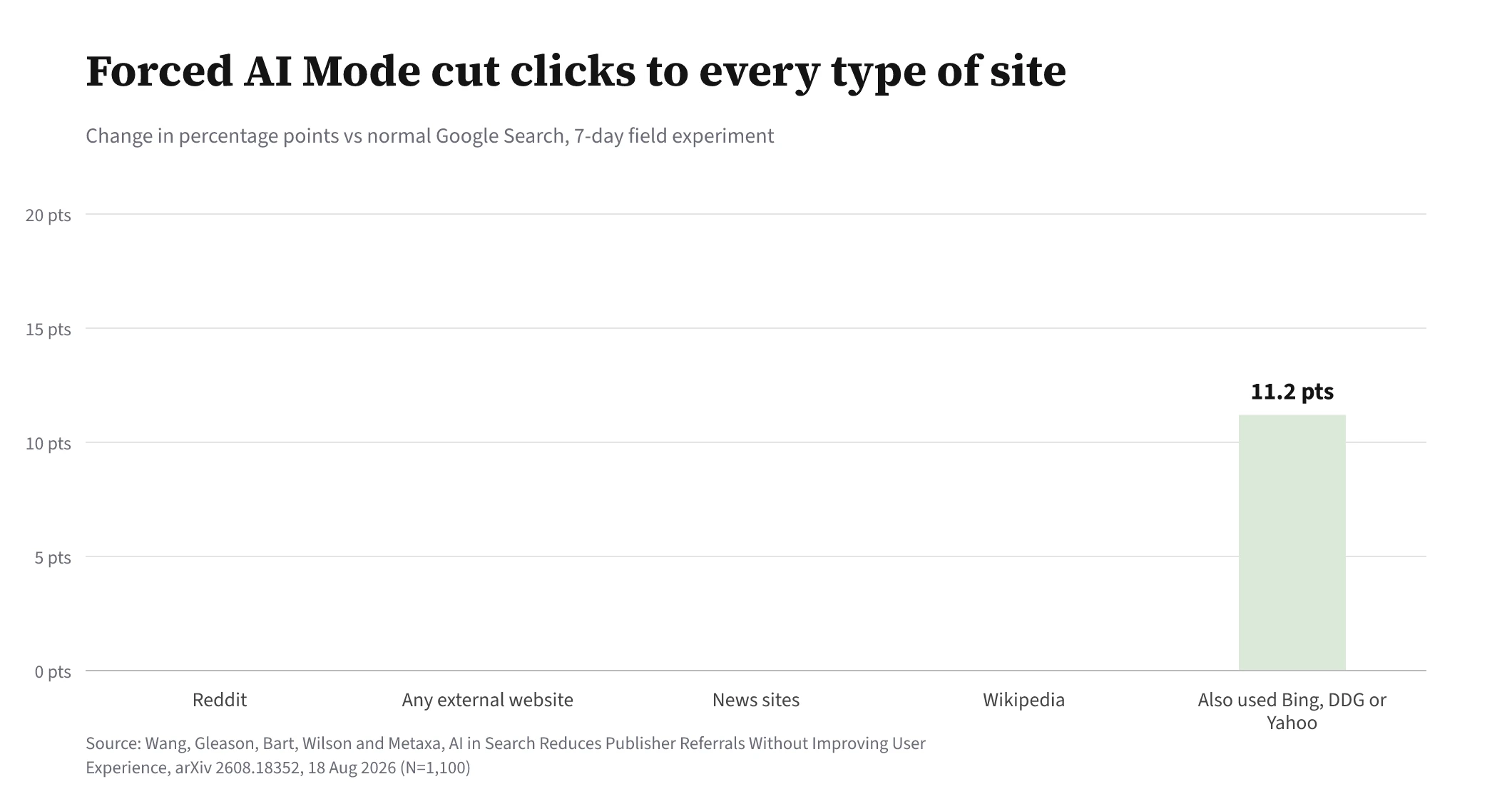
Why it matters: This is causal evidence, not a correlation pulled from a rank tracker. Look at who lost most: users clicking through to Reddit fell 21.2 points, news sites 12.5 and Wikipedia 9.9, according to the full text of the study. Those are sites that live on short, generic informational answers, which is exactly what an AI answer can replace.
Now the caveats, because they matter. The authors call forced AI Mode a “full-adoption scenario” not normal uptake. The sample skewed young, with 75% under 45, and it was US only. The redirect itself worked well, catching 94.7% of searches, so the result is solid for what it tests.
The user experience finding surprised us more than the click drop. In the follow-up survey, 33.6% of the AI Mode group gave negative feedback. The top complaints were loss of control (17.6%), trouble getting to specific websites (15.3%) and too few links or sources (13.4%). People wanted the web back.
Why Did Google’s Own Earnings Call Worry People About AI Mode?
Because Google admitted that AI Mode makes less money per search than classic results, and investors heard that as a threat to the core business.
On Alphabet’s Q3 call on 28 October, Philipp Schindler said “the strong growth in AI Mode queries had an impact because of the lower monetization we were seeing in AI Mode” according to the Motley Fool transcript of the Q3 2026 call. Alphabet lost about $482 billion in market value on 29 October, a Fortune figure reported by PPC Land’s analysis of the sell-off.
The panic skipped some detail. Schindler named exchange rates as the biggest cause of the slowdown, not AI Mode. Search revenue still grew 12% year on year to $63 billion. Sundar Pichai said Google’s “year-over-year query growth rate is the highest it’s been in the last 5 years.” That doesn’t sound like a search business in trouble.
For site owners, the useful part is simpler. An under-monetised product is a product Google wants to change. The two things it can change are ads and links, and both of those decide whether anyone reaches your website.
Is Google About To Replace Normal Search With AI Mode, Or Scale It Back?
Neither looks likely in the near term. The evidence points to Google blending AI Mode into everything else rather than switching anything off.
The “AI Mode button removed” story rests on a single X post from 30 October. Search Engine Roundtable could not replicate it and Google has not commented, as PPC Land reported on 4 November. In the same week, AI Mode ads went live in 10 more countries.
That second fact tells you more than the first. Companies don’t take ads to new markets for a product they plan to retire. On the earnings call, Schindler confirmed AI Mode ads are expanding internationally and that multi-turn ads are being added in the US. Pichai described Google as building a single experience across AI Overviews, AI Mode and traditional search.
Our view: stop watching for button tests. Google runs thousands of those. The direction is clear enough. AI answers are becoming part of every results page, and the question for you is whether your pages are the ones those answers link to.
Should You Worry More About AI Mode Or AI Overviews Right Now?
AI Overviews, for most businesses, today.
Key data: Before the experiment started, only 0.6% of participants’ searches used AI Mode, while 36% triggered an AI Overview, according to the Wang et al. study. That is a sixty-fold gap in exposure. Schindler also said on the Q3 call that “the majority of AI Mode queries are incremental” meaning most are new searches rather than ones taken from the classic results page.
The same study tested the reverse: hiding AI Overviews. Click-through rose by 8.8 points. Treat that figure with care, though. The extension hid 90% of AI Overviews on day one and that fell to 0% as the test went on, so it is weaker evidence than the AI Mode result.
Why it matters: If your clicks are falling while rankings hold, AI Overviews are the more likely cause right now. We covered the wider picture in 10 reasons your rankings hold but your clicks keep fallingand what actually earns a source link in what gets cited in AI Overviews. AI Mode is the bigger per-search hit, but on far less volume, for now.
| AI Overviews | AI Mode | |
|---|---|---|
| Share of normal searches in the Wang et al. baseline (US, March 2026) | 36% triggered one | 0.6% used it |
| Effect on clicks in the experiment | +8.8 pts when hidden (weaker evidence: hiding fell from 90% to 0%) | −18.8 pts when forced (94.7% of searches redirected) |
| What Search Console shows | Impressions, no clicks | Impressions, no clicks |
| Golf components case study links (derived split) | 1,148 of 1,244 | Part of 96 shared with ChatGPT, Perplexity and Gemini |
| Our priority | Biggest traffic issue today | Prepare now for long, specific queries |
Which Businesses Do Well When AI Mode Questions Get Long And Specific?
Businesses whose buyers ask detailed, specific questions, because that is exactly the kind of search AI Mode attracts.
Pichai said on the Q3 call that AI Mode queries are on average three times longer than traditional searches, and one in five AI Mode searches worldwide use voice, images or documents. Long questions are hard to answer from a generic article. They need a source that knows the subject properly.
We see this with a client that sells something technical. How a US golf components supplier earned 1,244 AI answer links sums it up: “Since starting with SEOValley in February 2026, a US supplier of golf club components has grown its top-5 Google rankings by 16% in eight months. AI answers in Google AI Overviews, AI Mode, ChatGPT, Perplexity and Gemini now link to its site as a source 1,244 times.”
The lesson is about the questions. This supplier’s buyers ask things like which shaft flex suits their swing, how to re-shaft a club, or which epoxy to use. A baseline AI visibility check in May 2026 showed which of those questions AI answers were sending to competitors instead.
There’s an honest detail on the same page. 1,148 of the 1,244 links sit inside Google’s AI Overviews. By our own arithmetic, that leaves 96 links across AI Mode, ChatGPT, Perplexity and Gemini combined. It matches the study neatly: AI Overviews are where the volume is today, and AI Mode is where it is heading.
Clicks can still grow while AI features spread, too. For a UK automotive parts retailer, “Organic search visits rose 33% in the latest 12 months” and its clicks from Google Search went from 5,530 in September 2025 to 6,190 in September 2026, up 12%. You can find more examples on our case studies page.
What Is Google Changing To Send More Clicks From AI Mode?
More links, placed higher, plus a test of a dedicated spot for official websites.
On 15 October, Hema Budaraju, VP of Product Management, wrote in More ways to connect with the web from Search that Google has made “continued and substantial increases” to inline links in AI answers and will show them higher up more often. Google will also test a section at the top of AI responses for the one or two official pages where a task gets done. Use of its Preferred Sources feature has grown more than 7x since the start of 2026.
Read that next to the study’s survey. Users complained about too few links and trouble reaching specific sites. Google earns less when people stay inside AI Mode. Both pressures push the same way, towards more links out. That makes it worth being the page those links point to.
Two moves we’d make now:
- Make your official pages the obvious answer. Pricing, booking, returns, delivery, specifications. If a task gets done on your site, the page for it should be clear, current and unambiguous, so it has a fair shot at that official-sites section.
- If you sell products, treat product data as visibility. Schindler said click-through rates are already similar between sponsored and organic product listings inside AI Mode. Accurate titles, prices, stock and attributes now affect organic exposure as well as paid. Our Google Shopping page covers the paid side.
Can You Measure AI Mode Traffic, And Should You Opt Out?
You can measure AI Mode impressions but not its clicks, and no, we wouldn’t opt out on the strength of this news.
Search Console’s Generative AI performance reports reached every website on 31 August 2026. They show impressions, pages, countries, devices and dates for AI Overviews and AI Mode. There is no click metric, and GA4 can’t separate AI Mode visits from ordinary Google traffic. So you are partly flying blind. We set out what you can track instead in how to measure AI visibility when there is no rank to track.
On opting out, the only data we have is thin. In a small test reported by Search Engine Roundtable on 30 OctoberCyrus Shepard estimated a click-through rate of about 0.9% on impressions from AI features, which made up about 8% of total impressions. But regular organic clicks also fell while the site was opted out. Barry Schwartz called it a “super limited study” and it is one site, so treat it as an anecdote.
Even so, it points the same way as our earlier advice in should you opt out of Google’s AI Overviews? Removing yourself from AI answers doesn’t hand you back the old ten blue links. It can cost you some of those too.
Here’s where we land. AI Mode sends fewer clicks per search, and the evidence for that is strong. But it is still a small slice of Google, AI Overviews are hitting far more of your searches today, and Google has commercial reasons to push more links out of AI Mode, not fewer.
So check your Search Console AI impressions, tidy up the official pages where customers actually get things done, fix your product data if you sell online, and build content around the long, specific questions your buyers ask. Don’t opt out in a panic. If you’d like a second opinion on where your site stands in AI answers, our AI SEO service is the place to start.
About The Author
Shabir MS leads SEOValley Solutions and has worked in search since 2005. These days most of his time goes on how brands show up in AI answers, and on separating what the data actually shows from what gets said at conferences. Read more from Shabir MS.
Frequently Asked Questions
Can I see how many clicks AI Mode sends me in Search Console or GA4?
Not yet. Search Console’s Generative AI reports show impressions for AI Overviews and AI Mode but no click metric, and GA4 can’t separate AI Mode visits from normal Google traffic.
Is Google going to make AI Mode the default and remove the normal results?
There’s no sign of that. Pichai described building one experience across AI Overviews, AI Mode and traditional search, and the missing-button report rests on one X post that Search Engine Roundtable couldn’t replicate.
Now that ads are coming to AI Mode, will organic links get pushed further down?
Ads are expanding to more countries and multi-turn ads are coming in the US, so competition for space will grow. Google also said on 15 October that it is adding more inline links and showing them higher, so watch your Search Console impressions rather than assuming the worst.
Does any of this apply outside the US?
The experiment was US only. But Pichai’s figure that one in five AI Mode searches use voice, images or documents is worldwide, and AI Mode ads went to 10 more countries in early November, so expect the same pressures elsewhere.
How do I get my product listings or official pages shown inside AI Mode answers?
Nobody can promise inclusion. The sensible moves are to make your official task pages clear and current, and for retailers to keep product data accurate, since organic product listings in AI Mode already see click-through rates similar to ads.
Should I write content differently for long AI Mode questions?
Answer the specific questions your buyers actually ask, fully and accurately, rather than chasing short generic keywords. The sites that lost most in the study lived on short informational answers.