+91 9893014167
 1 (888) 316-3286
 +44 20 3807 2189
 Chat on WhatsApp



You ask ChatGPT for the best suppliers in your trade and your company is on the list. You type the same question into Gemini. Nothing. Copilot gives you a third answer with names you’ve never heard of.
So does visibility on one AI engine carry over to the others? Partly, and much less than most people assume. Semrush’s October data shows any two major AI platforms share only 63 to 70 of their top 100 brands in the UK, and each engine now draws on different inputs: Google’s index, Bing’s index, merchant product feeds. The groundwork carries over. Most of the rest has to be done engine by engine.
Key Facts
- Semrush’s 2026 AI Visibility Index, published on 13 October 2026, found that any two of ChatGPT, Gemini, Google AI Mode and AI Overviews shared on average 63 to 70 of their top 100 mentioned brands in the UK, against 70 to 78 in the US.
- Semrush’s study of 126 million US prompts, published on 26 June 2026, found ChatGPT cites about 15 sources per response while Gemini cites about 3.
- Profound data reported by Search Engine Journal on 9 September 2026 showed the share of ChatGPT Shopping recommendations coming from product feeds jumped from 8.26% to 61.54% on 10 July 2026.
- Google’s guide to generative AI features in Search, last updated on 10 July 2026, says llms.txt will neither harm nor help because Google Search ignores it.
- Bing added Topics Portfolio (beta) to its AI Performance report in Bing Webmaster Tools on 13 October 2026.
- Microsoft announced on 30 October 2026 that separate AI Training and AI Grounding settings will be honoured from 1 February 2027, replacing NoArchive and NoCache.
Below I go through what the latest data from Semrush, Profound, Google and Microsoft says about each engine, where our own client results fit, and which jobs carry over to every engine versus the ones you have to do separately.
If ChatGPT Recommends You, Will The Other AI Engines Do The Same?
Not reliably. Semrush’s 2026 AI Visibility Index and first UK benchmarkpublished on 13 October, tracked fixed monthly sets of 2.5 million UK prompts and 25 million US prompts across ChatGPT, Gemini and Google AI Mode from January to July, plus a separate AI Overviews dataset. On average, any two platforms shared 63–70 of their top 100 mentioned brands in the UK and 70–78 in the US.
Put the other way round: roughly a third of the brands one engine favours in the UK don’t make another engine’s top 100 at all.
Key data: AI Overviews had the lowest brand-mention overlap with the other platforms in all seven months. AI Overviews paired with ChatGPT had the lowest source overlap of any two platforms. And in Semrush’s earlier study of 126 million US promptsonly 36 brands stayed in the top 100 on all four platforms in every month from January to April.
Why it matters: If you track one engine and assume the rest follow, you are either flattering yourself or worrying for nothing. Thirty-six brands is a very small club.
The UK figure is the one that caught my eye. British businesses should expect the engines to disagree more than their American competitors see, not less.
Why Does An AI Name My Brand But Link To Someone else’s Page?
Because being mentioned and being cited are two separate results, and each engine handles them differently. Semrush found that fewer than half of the top 100 mentioned brands also appeared among the top 100 cited domains, in every month and in both markets. In the UK the overlap was 36.7 to 45.3 domains out of 100.
What it looks like: In July, Tesco was ChatGPT’s 25th most-cited UK domain and Asda was 606th, even though both were among the top 100 mentioned brands on all four platforms in every month. On Gemini, the same two ranked 29th and 60th. Same household names, very different link treatment.
Key data: On Gemini, Semrush says the overlap between mentioned brands and cited domains “can be as low as 30%”.
We see the same gap in our own results, only the other way round. Our Australian tiny house builder’s AI search results show the site linked 2,883 times but named 1,065 times. For that client, links ran well ahead of the name. For Asda on ChatGPT, the name ran well ahead of the links.
Why it matters: A mention builds awareness. A citation can send you a visitor. Decide which one you are reporting on, and be wary of any report that adds the two together.
Does Google’s AI Simply Follow Google Rankings?
Largely, yes, and Google says so itself. Its guide to optimising for generative AI features in Google Searchlast updated on 10 July 2026, tells site owners they can ignore content “chunking”, llms.txt files and inauthentic mentions. It says llms.txt will “neither harm nor help” because Google Search ignores it, that structured data isn’t required for its AI features, and that no special schema is needed. For measurement, it points you to the Generative AI performance report in Search Console.
That runs against a lot of the GEO advice doing the rounds. For Google’s own products, I take Google at its word. The guide says nothing about ChatGPT or Copilot, though, so don’t stretch it.
On 15 October Google also announced more links from AI Overviews and AI Modedescribing “continued and substantial increases” to inline links and saying they will appear higher up. It is testing a section at the top of some answers that surfaces the one or two official sites for a task. It added that use of Preferred Sources has grown more than 7x since January, without giving a baseline.
What it looks like in our work: Our Australian cold chain packaging manufacturer case study is the clearest example. The manufacturer “has more than tripled its top-10 Google rankings since SEOValley expanded its monthly SEO programme in October 2024, from 227 keywords to 702, the highest the site has ever recorded. AI answers in Google AI Overviews, AI Mode, Perplexity and ChatGPT now link to its pages 298 times.” Google’s AI Overviews link to its product pages for 217 different searches.
The lesson is how ordinary the work was: re-optimising pages based on what was ranking, fixing a product schema problem that showed the wrong images in search results, adding FAQ schema, and repeated backlink clean-ups. None of it was an AI trick. The schema fix corrected what searchers saw, and the AI links came mostly through Google’s own AI surfaces.
Our US golf components supplier shows the pattern even more sharply. Of 1,244 links in AI answers across all engines, 1,148 sit inside Google’s AI Overviews. That’s about 92% from a single Google surface. You’ll find more results like these in our SEO case studies.
For the Google side in more depth, see our September post on what gets cited in AI Overviews and how it changes by query.
Why Does ChatGPT Shopping Now Depend On Product Feeds?
Because that is where most of its product picks now come from, at least in the prompts Profound tracks. Search Engine Journal reported on 9 September that the share of ChatGPT Shopping recommendations Profound classes as feed-sourced jumped from 8.26% to 61.54% on 10 July, across 1,757,723 tracked prompt runs. By 3 September, feeds accounted for about 65%.
Key data: According to Profound’s analysis of the Shopping change450 of 687 tracked merchants lost at least a third of their Shopping visibility and 67 gained at least a third, comparing 7–9 July with 10–12 July. The top 10 merchants’ share of references rose from 22.5% to 41.8%. The number of different merchants referenced fell from 13,524 to 10,607.
Treat this with some care. It is observational data from Profound’s own prompts, not all ChatGPT traffic, and OpenAI has not confirmed the link Profound draws to the GPT-5.6 release.
What OpenAI does say, in its Shopping with ChatGPT Search help pageis that product results are “selected independently by ChatGPT and are not ads”. They are chosen using structured product data such as price and description, from merchants and third-party providers. Shopify merchants are already connected through Shopify Catalog. Other merchants can apply for direct feed access. Shopping is US-only for now.
Why it matters: If you sell in the UK or Australia, there is nothing to switch on yet. If you sell in the US with a messy feed, you are handing ground to the big ten, who nearly doubled their share overnight. The discipline is the same one behind Google Shopping: accurate prices, descriptions and product details that match the page.
What’s Different About Copilot And Bing?
Copilot draws on Bing, and Bing now gives site owners its own report and its own controls. Bing Webmaster Tools launched its AI Performance report in February 2026. On 13 October it added Topics Portfolio (beta)which groups the questions where your site is cited in Copilot and Bing AI answers into topics.
What it looks like: For each topic you see how much citation demand there is and how many sites are cited for it. There is also a list of “Opportunity Queries” where competitors are cited and you aren’t. Bing says to treat the numbers as directional, which is a fair warning for a beta.
Then on 30 October, Microsoft split its content controls into training and grounding. Grounding means using your page to build an AI answer. From 1 February 2027 Microsoft will honour a separate AI Training setting and AI Grounding setting, replacing NoArchive and NoCache. Sites that use those must switch by 1 March 2027, or the preferences stop being read.
Key data: Microsoft states that choosing Disallow or DisallowExtended for grounding means “you will see reduced brand visibility in AI experiences”. DisallowExtended still allows Microsoft’s own AI features, such as Copilot, but blocks third-party grounding such as Web IQ.
Why it matters: Microsoft is being unusually blunt about the trade-off. You can now refuse training and stay in answers. Refuse grounding and, by Microsoft’s own account, your visibility drops. We weighed a similar choice for Google in should you opt out of Google’s AI Overviews?
Why Is Gemini The Hardest Engine To Get Into?
Because it cites so few sources. Semrush’s June study found ChatGPT cites about 15 sources per response and Gemini about 3. That is five times fewer seats at the table, before you even get to who fills them.
Google’s AI Mode concentrates too. In the UK, its top 10 source domains took 23.2%–35.8% of citations, against 12.8%–15.4% for ChatGPT. A handful of big sites take a large slice.
Where there is room depends heavily on your industry. The same June study measured how much of each category’s AI visibility the three most visible brands hold.
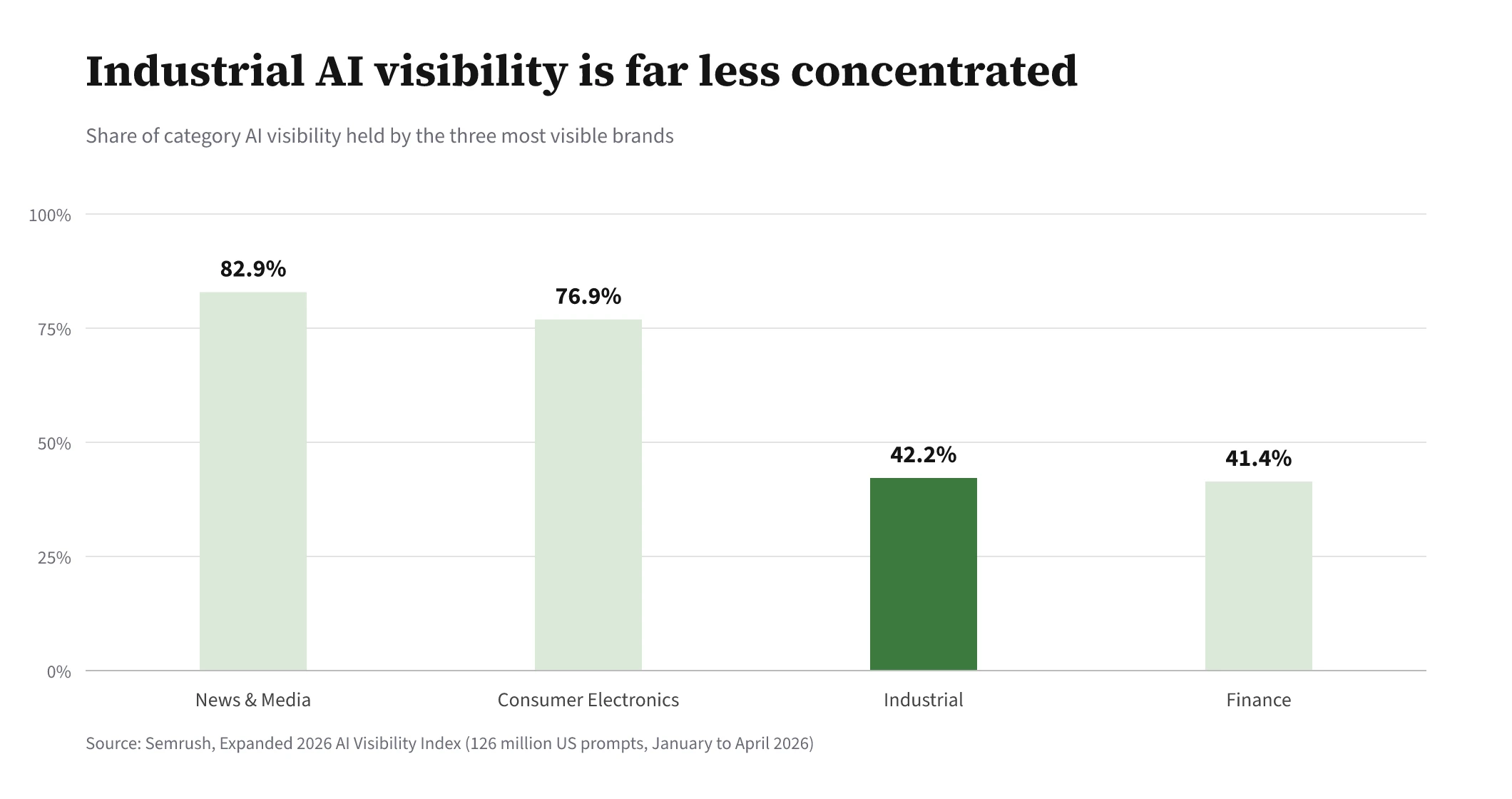
News and consumer electronics are close to locked up. Industrial and finance are far more open, with the top three holding around 42%. That is encouraging for mid-sized manufacturers like our packaging client, and it is a reminder to check your own category before deciding an engine is out of reach.
| Engine | Main input | Report for site owners | What the latest data says |
|---|---|---|---|
| Google AI Overviews and AI Mode | Google’s index; largely follows Google SEO | Generative AI performance report in Search Console | Google says ignore llms.txt and chunking; more inline links announced 15 Oct 2026 |
| ChatGPT answers | Web sources, about 15 per response | None covered in our sources | Lowest source overlap with AI Overviews; UK citations lean on news (29.5%) |
| ChatGPT Shopping (US only) | Merchant and third-party product feeds | None covered in our sources | About 65% of tracked picks came from feeds by 3 Sep 2026 (Profound) |
| Copilot and Bing AI | Bing’s index | AI Performance report with Topics Portfolio (beta) | Separate training and grounding settings from 1 Feb 2027 |
| Gemini | Web sources, about 3 per response | None covered in our sources | Mention-to-citation overlap can be as low as 30% |
What Carries Over To Every Engine, And What Has To Be Done Separately?
The base carries over: a crawlable site, accurate product data and mentions on other people’s sites. After that, SEOValley’s view is that there is no single “AI ranking”. There are four channels sharing one foundation, and each needs its own job done.
- Keep doing Google SEO. AI Overviews and AI Mode come from Google’s index and largely follow it, and they are the AI surfaces most of our clients actually appear in.
- Verify your site in Bing Webmaster Tools and read the AI Performance report. It is the clearest view of Copilot citations you will get.
- If you are a US retailer, get a product feed into ChatGPT. Shopify sites already have one through Shopify Catalog. Others can apply for direct access.
- Earn mentions in the publications each market’s AI trusts. On ChatGPT, news sites made up 29.5% of top-100 citations in the UK against 19.6% in the US. UK brands need press coverage more, which is where digital PR earns its keep.
Track each engine separately as well. A blended AI visibility score hides exactly the differences this article is about. Our post on how to measure AI visibility when there is no rank to track covers that.
One honest caveat. Our data shows Google SEO feeding Google’s AI surfaces, clearly and repeatedly. It cannot prove that work aimed at Google carries over to ChatGPT. Anyone who tells you it does, with certainty, is guessing.
Start with what you can already see. Check Search Console’s Generative AI performance report, verify your site in Bing Webmaster Tools before Microsoft’s new settings take effect on 1 February 2027, and if you sell in the US, find out whether your products reach ChatGPT through a feed.
Then judge each engine on its own numbers rather than one blended score. If you’d like a second opinion on where your brand stands across them, our AI SEO service is where we’d start that conversation.
About The Author
Shabir MS leads SEOValley Solutions and has worked in search since 2005. These days most of his time goes on how brands show up in AI answers, and on separating what the data actually shows from what gets said at conferences. Read more from Shabir MS.
Frequently Asked Questions
Which AI engine should a small business work on first?
Google’s AI Overviews and AI Mode, because they draw on Google’s index and largely follow ordinary Google SEO. After that, verify your site in Bing Webmaster Tools so you can see your Copilot citations.
Do I need a product feed for ChatGPT if I’m outside the US or not on Shopify?
ChatGPT Shopping is US-only for now, so outside the US there is nothing to connect yet beyond keeping your product data accurate. In the US, Shopify merchants are already connected through Shopify Catalog, and other merchants can apply to OpenAI for direct feed access.
How can I see when Copilot or Gemini cites my site, and is there a free way?
For Copilot, Bing Webmaster Tools has a free AI Performance report, now with Topics Portfolio in beta. For Google’s AI features in Search, use the Generative AI performance report in Search Console. None of our sources describe an owner report for the Gemini app or ChatGPT, so those need separate tracking.
Should I use Microsoft’s new grounding setting to block my content?
Only if you accept losing visibility, because Microsoft says Disallow or DisallowExtended for grounding means reduced brand visibility in AI experiences. If your concern is model training, the separate AI Training setting, honoured from 1 February 2027, lets you refuse training without leaving AI answers.
Why does AI name my competitor but link to my page, or the other way round?
Mentions and citations are separate results. Semrush found fewer than half of the top 100 mentioned brands also appear among the top 100 cited domains, so it is common to be named without a link, or linked without being named.
Do llms.txt or special schema help with any AI engine?
For Google, no: its guide says llms.txt will neither harm nor help and that no special schema is needed for its AI features. Accurate structured product data in feeds is a different matter, since OpenAI says ChatGPT Shopping selects products using data such as price and description.